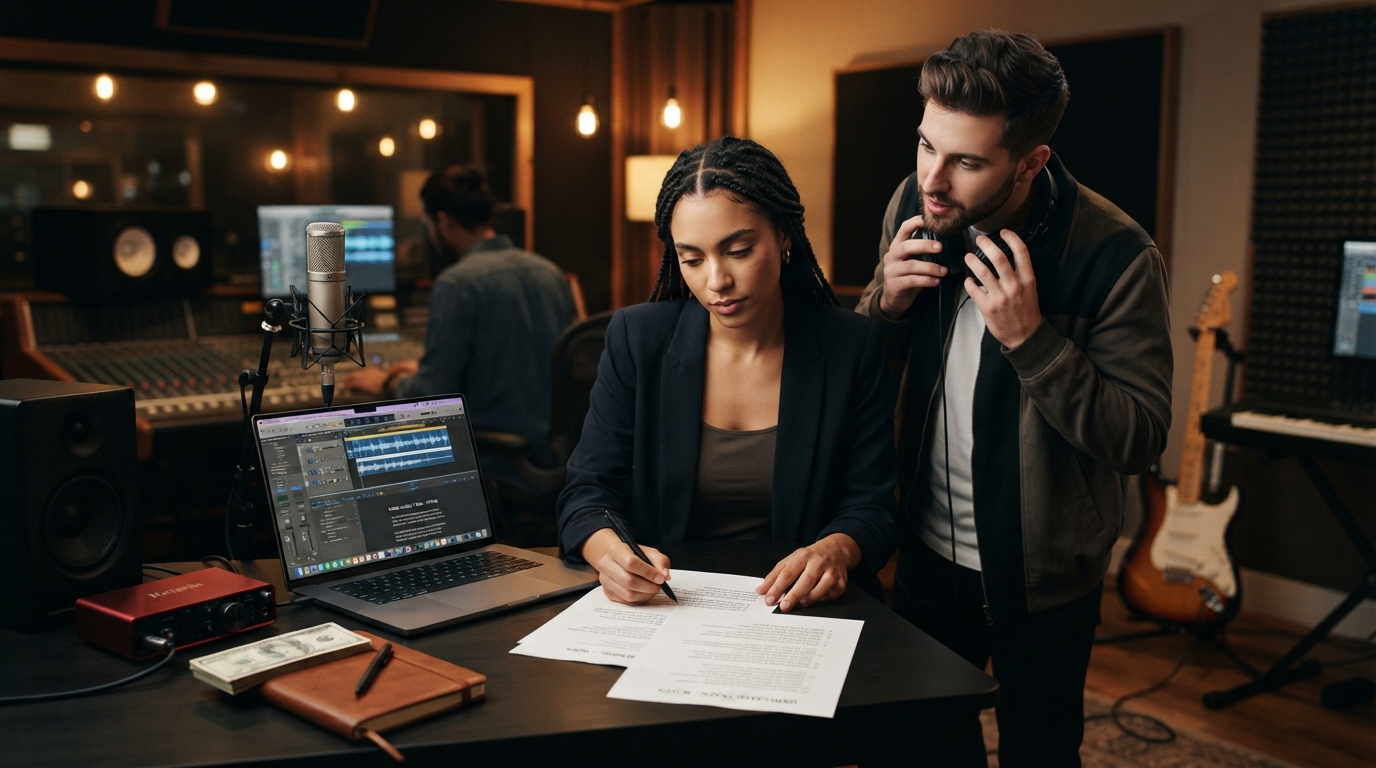
On average, a professional music ghostwriter makes between $500 to $10,000+ per song in flat upfront fees, depending on their industry reputation, the client’s budget, and the musical genre. While independent or emerging artists typically pay between $250 to $1,500 per track, major-label projects command advance fees ranging from $5,000 to over $30,000. Beyond upfront cash, modern ghostwriting compensation often includes a hidden share of publishing royalties (typically 10% to 50% via split sheets), performance royalties collected by PROs like ASCAP or BMI, and mechanical royalties, despite the signing of strict Non-Disclosure Agreements (NDAs).
The music industry is built on secrets, and none is more closely guarded than the use of ghostwriters. From hip-hop and pop to country and electronic dance music (EDM), behind some of the world’s biggest chart-topping hits stands an anonymous force of elite lyricists, top-liners, and melody makers. For these creators, the financial landscape is complex, blending flat-rate work-for-hire agreements, backend publishing percentages, and performance rights payouts. Understanding the true earning potential of a song ghostwriter requires pulling back the curtain on entertainment law, royalty collection models, and industry-standard negotiation tactics.
The Financial Spectrum: How Much Do Ghostwriters Make Per Song?
The compensation for writing a song without receiving public credit varies wildly. Unlike public songwriters who can leverage their charting history for massive upfront advances, ghostwriters operate in a shadow market where pricing is determined by leverage, track record, and the project’s projected commercial success.
To understand the earning brackets, we must categorize ghostwriters into three primary tiers: Indie/Emerging, Mid-Tier Professional, and Elite/A-List Industry Veterans.
1. The Indie and Emerging Tier ($250 – $1,500 per song)
At this level, ghostwriters work primarily with local artists, independent creators, and social media influencers looking to launch music careers. These transactions are almost exclusively flat-fee “work-for-hire” arrangements. The ghostwriter delivers the lyrics, vocal guides, or reference tracks, signs a basic release form, and forfeits all future rights to the song. Royalties are rarely part of the equation here, as indie releases seldom generate significant streaming revenue or radio play.
2. The Mid-Tier Professional ($1,500 – $5,000 per song)
These are seasoned musicians, session singers, and independent producers who have established a reputation within regional music scenes or digital marketplaces. They often write for mid-level indie label artists, rising streaming stars, or commercial sync licensing libraries. At this level, ghostwriters can negotiate a hybrid payment model: a respectable upfront advance combined with a small percentage of the writer’s share of publishing royalties (usually 10% to 25%), which is kept quiet via private split sheets.
3. The Elite and A-List Tier ($5,000 – $30,000+ per song)
This is the upper echelon of the music industry. These ghostwriters are often Grammy-nominated songwriters or producers who ghostwrite to maintain cash flow without over-saturating their public brand, or to help major-label artists who are struggling to finish albums. These deals involve high-stakes legal negotiations handled by entertainment lawyers. Upfront fees start at $5,000 and can easily exceed $30,000 for a single hook, verse, or full song arrangement. Crucially, these elite ghostwriters secure substantial backend percentages (up to 50% of publishing) while signing ironclad Non-Disclosure Agreements (NDAs) that legally forbid them from ever revealing their involvement in the track.
Upfront Fees vs. Backend Royalties: How Ghostwriters Get Paid
A common misconception is that ghostwriters only receive a one-time flat payment. In the modern music ecosystem, relying solely on upfront fees is a recipe for financial instability. Successful ghostwriters structure their contracts to capture both immediate cash flow and long-term passive income.
| Payment Component | Average Rate Range | Pros | Cons |
|---|---|---|---|
| Flat Upfront Fee (Work-for-Hire) | $500 – $15,000 | Immediate cash flow; no reliance on song’s commercial success. | No long-term residual income if the song becomes a massive hit. |
| Publishing Royalties (Writer’s Share) | 10% – 50% | Generates passive income via radio, streaming, and live performance. | Takes 6-18 months to pay out; requires administrative tracking. |
| Mechanical Royalties | Statutory rate (currently 12.4 cents per physical/digital sale) | Directly tied to sales and interactive streams. | Streaming payouts per play are extremely small (fractions of a cent). |
| Sync Licensing Fees | 25% – 50% of the sync fee | High-paying placements in movies, TV shows, and video games. | Unpredictable; highly dependent on music supervisors’ selections. |
The Power of the “Split Sheet” in Ghostwriting
A split sheet is a simple but legally binding document that outlines exactly who wrote what percentage of a song. Even if a ghostwriter’s name is kept off the public credits on Spotify, Apple Music, or physical vinyl sleeves, their legal name can still be registered on the backend with Performance Rights Organizations (PROs) like ASCAP, BMI, SESAC, or PRS.
Through these private split sheets, a ghostwriter can quietly collect their writer’s share of royalties. Because PRO databases are not easily cross-referenced by the general public, the artist maintains their reputation as a sole songwriter, while the ghostwriter’s bank account receives quarterly royalty distributions.
The Legal Framework: NDAs, Work-For-Hire, and Buyouts
The legal structure of a ghostwriting agreement dictates how much money a writer makes both today and in the future. There are three primary legal avenues used in these transactions:
1. The Non-Disclosure Agreement (NDA)
The NDA is the cornerstone of the ghostwriting industry. It is a legally binding contract that prevents the ghostwriter from disclosing their involvement in a song, album, or project. Violating an NDA can result in severe financial penalties, lawsuits, and the immediate forfeiture of all past and future royalties associated with the track. The inclusion of a strict NDA usually increases the upfront fee, as the writer is selling not just their talent, but also their silence.
2. Work-For-Hire Agreements
Under a standard work-for-hire contract, the ghostwriter is legally considered an employee or independent contractor hired to create a specific asset. In this scenario, the person or entity paying for the work (the artist or the record label) is legally designated as the “author” and owner of the copyright from the moment of creation. The ghostwriter has zero legal claim to the song, its royalties, or its master rights.
3. Full Copyright Buyouts
In a buyout, the ghostwriter may initially own a portion of the copyright but agrees to sell all of their rights, titles, and interests in the composition to the artist or label for a lump sum. Buyouts are expensive. If a record label realizes a ghostwritten track has massive hit potential, they may offer the ghostwriter a $20,000 to $100,000 buyout to completely sever the writer’s connection to the song’s future earnings.
How Genre Influences Ghostwriting Rates
The demand, operational style, and financial compensation for ghostwriters vary heavily across different musical genres. Hip-hop, pop, country, and EDM each have distinct cultural norms regarding ghostwriting.
Hip-Hop and Rap: The Culture of Co-Writing and Ghosting
In hip-hop, authenticity is highly valued, making ghostwriting a highly sensitive topic. Despite this, ghostwriting is rampant. In rap, ghostwriters are often hired to write entire 16-bar verses, craft catchy hooks, or structure complex rhyming schemes. Because of the stigma, upfront fees in hip-hop can be very high, ranging from $2,500 to $20,000 per verse for established ghostwriters. If the ghostwriter also acts as a “reference vocalist” (recording a guide track so the rapper knows how to deliver the flow, cadence, and inflection), the price increases significantly.
Pop and R&B: The Top-Lining Goldmine
Pop music rarely hides its collaborative nature, though true “ghostwriting” (where a writer gets zero public credit) still occurs to protect an artist’s “singer-songwriter” persona. In pop, ghostwriters are frequently hired as “top-liners.” A top-liner’s job is to write the vocal melodies, lyrics, and hooks over a pre-existing instrumental beat. Pop ghostwriting is highly lucrative because of the sheer volume of commercial radio play and streaming. A successful pop hook can net a ghostwriter tens of thousands of dollars in quiet backend publishing royalties alone.
Country Music: The Nashville Co-Writing Engine
Nashville operates on a highly structured co-writing system. While true ghostwriting is less common here—most writers are publicly credited—it does happen when major stars want to claim solo writing credits on deeply personal ballads. Country ghostwriters are typically paid a modest upfront fee but negotiate heavily for mechanical and physical sales royalties, as country music fans still purchase physical media and digital downloads at higher rates than fans of other genres.
Electronic Dance Music (EDM): Ghost Producing and Vocal Writing
In EDM, ghostwriting often extends to “ghost producing,” where an anonymous producer creates the entire instrumental track for a celebrity DJ. However, lyric and vocal ghostwriting are also highly sought after. EDM ghostwriters write the emotional, anthemic vocal hooks that elevate instrumental tracks into crossover radio hits. These deals often pay $1,000 to $5,000 upfront, combined with a share of the performance royalties generated when the track is played at massive festivals and nightclubs worldwide.
Real-Time Search Queries: What Aspiring Songwriters Ask
To provide a clear picture of the industry, let us address the most common real-time search queries regarding the financial and operational realities of song ghostwriting.
“Do ghostwriters get royalties?”
Yes, but it depends entirely on the contract. In a pure “work-for-hire” agreement, ghostwriters do not receive royalties. However, in professional industry settings, ghostwriters frequently secure a percentage of the publishing royalties (the writer’s share) through private split sheets. This allows them to collect royalties through PROs like ASCAP or BMI without their name appearing on the public-facing credits of streaming platforms.
“How do I become a ghostwriter for rappers?”
Breaking into hip-hop ghostwriting requires a mix of exceptional lyricism, understanding of modern cadences, and networking. Most ghostwriters start as independent artists, battle rappers, or producers. By building a catalog of high-quality reference tracks and networking with managers, A&Rs, and studio engineers, writers can position themselves to be called upon when an artist is struggling with writer’s block in the studio.
“Who is the highest-paid ghostwriter?”
Due to strict NDAs, the highest-paid ghostwriters are officially anonymous. However, industry insiders know that legendary songwriters like Max Martin, Ester Dean, and Ne-Yo have written massive hits for other artists, sometimes under pseudonyms or completely uncredited ghost arrangements early in their careers. Elite ghostwriters can earn millions of dollars annually through a combination of high-end upfront consulting fees and catalog publishing assets.
How to Negotiate Your Rates as a Song Ghostwriter
If you are a talented lyricist or composer looking to monetize your skills behind the scenes, negotiating your rate is the most critical step in protecting your financial future. Here is a step-by-step guide to structuring your deals:
- Assess the Artist’s Budget and Backing: Is the artist signed to a major label, an indie label, or completely self-funded? Major labels have dedicated recording budgets and can afford higher upfront advances ($5,000+), while independent artists will require more flexible pricing.
- Determine the Scope of Work: Clearly define what you are delivering. Are you writing just the lyrics? The vocal melody (top-line)? Providing a fully recorded vocal reference track? The more elements you provide, the higher your fee should be.
- Always Ask for a Piece of the Publishing: Unless you are receiving an exceptionally high upfront fee that completely covers your time and intellectual property value, never sign away 100% of your publishing. Insist on a private split sheet registering your legal name with ASCAP or BMI for at least 10% to 25% of the writer’s share.
- Include a “Kill Fee” in Your Contract: Sometimes, artists record a song but decide not to release it. A kill fee ensures that you are still compensated for your time, writing, and creative energy even if the song never sees the light of day.
- Consult an Entertainment Attorney: Never sign an NDA, work-for-hire agreement, or copyright buyout without having a qualified entertainment lawyer review the terms. A single bad clause can cost you thousands of dollars in future revenue.
The Creative Pivot: Ghostwriting Beyond the Music Industry
While writing chart-topping songs is highly prestigious, the competitive nature and unpredictable royalty structures of the music business lead many talented writers to diversify their income. Many creative professionals apply their narrative structure, lyricism, and storytelling capabilities to other lucrative sectors of the writing industry.
For those looking to expand their writing careers into books, memoirs, speeches, or corporate storytelling, collaborating with established agencies like Geeks Ghostwriting can help creative professionals transition their storytelling skills into high-paying literary and commercial writing formats. Book ghostwriters often command fees ranging from $15,000 to over $100,000 per project, offering a highly stable and structured alternative to the volatile music market.
Frequently Asked Questions
Is ghostwriting songs illegal?
No, ghostwriting is entirely legal. It is a standard business contract where one party agrees to write creative material for another party in exchange for financial compensation, voluntarily forfeiting their public credit. As long as both parties consent to the terms in a signed contract, the arrangement is legally binding.
What is the difference between a co-writer and a ghostwriter?
A co-writer is publicly credited on the song’s metadata (e.g., on Spotify, Apple Music, and CD liner notes) and shares in the public recognition and royalties. A ghostwriter performs the same creative work but agrees to keep their involvement completely secret, usually in exchange for a higher upfront payment and non-disclosure terms.
Can a ghostwriter sue an artist for credit later?
If a ghostwriter signed a valid work-for-hire agreement or a contract with a clear waiver of moral and attribution rights, they cannot sue for credit. However, if the artist violated the payment terms of the contract, or if no written contract was ever signed, the ghostwriter may have grounds to sue for copyright infringement or breach of contract.
Do ghostwriters get paid if the song flops?
Yes, if they negotiated a flat upfront fee. This is the primary benefit of upfront pricing models; the ghostwriter is guaranteed compensation for their labor regardless of how the public receives the song or how many streams it accumulates.
How do ghostwriters track their quiet royalties?
Ghostwriters track their royalties by ensuring their legal name (or an official publishing alias) is registered alongside the artist’s name on the work registration forms with PROs like BMI, ASCAP, or PRS. The PRO manages the collection and distribution of royalties directly to the writer’s private account, bypassing the artist entirely.