
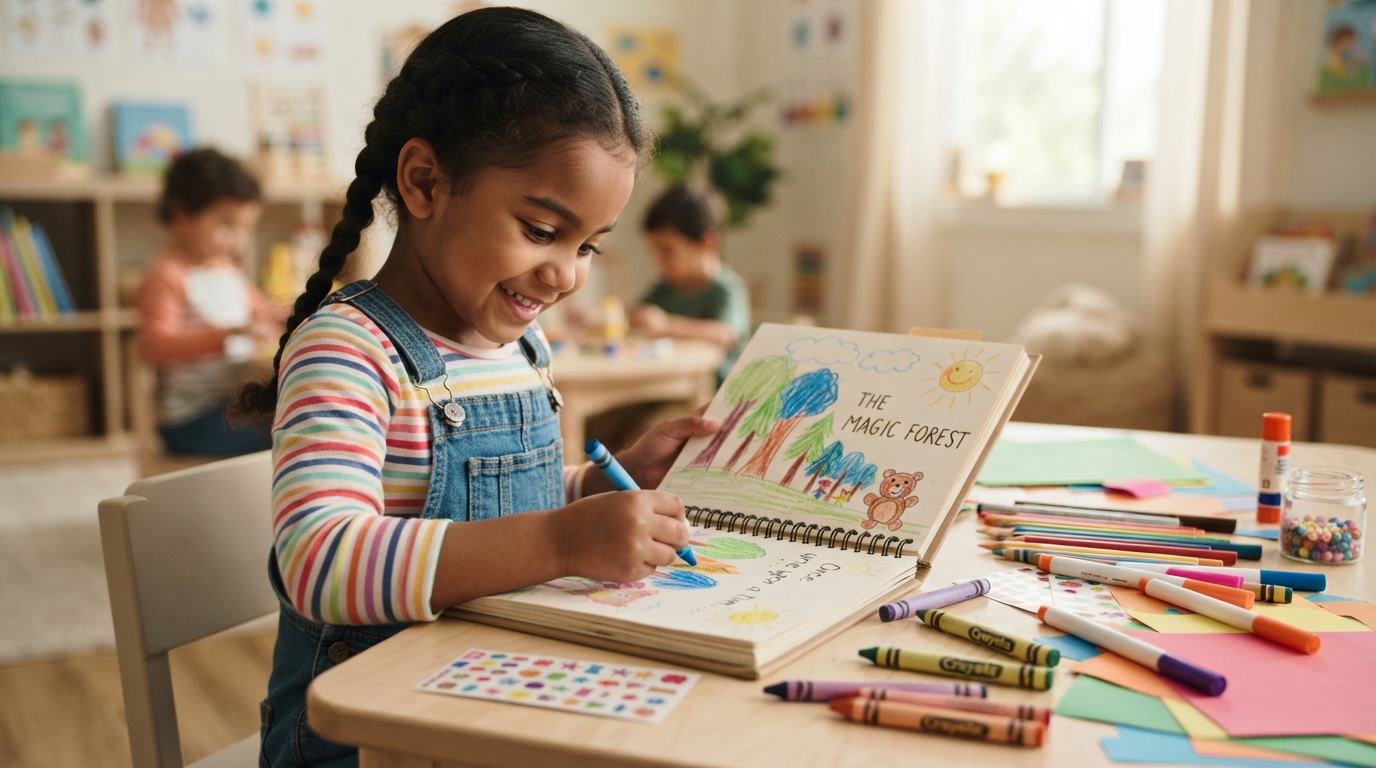
To learn how to create a storybook for kindergarten, you must craft an engaging narrative of 200 to 500 words tailored to children ages 4 to 6, establish relatable characters, select a child-centered theme, integrate vibrant full-color illustrations, and format the manuscript into a standard 32-page picture book layout. Success requires balancing early childhood literacy development, rhythmic pacing, phonological awareness, and visual storytelling to capture young attention spans while supporting reading readiness.
Creating picture books for early childhood education demands a delicate balance of pedagogical insight, creative writing, visual aesthetics, and mechanical precision. Kindergarteners are at a pivotal developmental stage where they transition from passive picture listeners to active visual decoders and emergent readers. Authors, educators, and independent self-publishers seeking to craft memorable children’s literature must understand how typography, color theory, story arcs, vocabulary limits, and page turns work together to foster a lifelong love of reading.
Understanding Kindergarten Child Development and Reading Readiness
Before putting pen to paper, you must understand the cognitive, emotional, and linguistic capabilities of five- and six-year-olds. Children in this demographic are concrete thinkers who rely heavily on visual cues to interpret meaning. Their working memory is expanding, but complex subplots, passive voice, or abstract metaphors will cause disengagement.
Kindergarten literacy instruction centers on foundational phonetic skills, sight-word acquisition, and print awareness. The table below outlines key developmental milestones and how your picture book manuscript should support them:
| Developmental Stage | Cognitive / Literacy Skill | Storybook Implementation Strategy |
|---|---|---|
| Phonemic Awareness | Recognizing sounds, syllables, and rhymes | Incorporate alliteration, rhythm, refrains, and assonance. |
| Print Awareness | Understanding that print carries meaning from left to right | Use large, legible fonts with clean spacing and distinct text placement. |
| Visual Literacy | Interpreting narrative through pictures | Ensure illustrations provide context clues that explain unfamiliar vocabulary. |
| Socio-Emotional Growth | Navigating empathy, sharing, fears, and routines | Feature protagonist dilemmas centered on school, family, friendship, or bedtime. |
Choosing Kindergarten Themes and Core Concepts
Kindergarteners engage most with stories that reflect their daily lives or invite them into safe, imaginative play. The goal is to present a problem that feels significant to a five-year-old and resolve it with authenticity, warmth, and clarity.
- First-Time Experiences: The first day of school, visiting the dentist, riding the school bus, sleeping without a nightlight, or making a new friend.
- Emotional Regulation: Managing anger, feeling shy, dealing with frustration when learning a skill, or understanding empathy and kindness.
- Humor and Absurdity: Slapstick situations, playful animal antics, upside-down logic, and unexpected surprises that elicit laughter.
- Concept-Driven Fiction: Integrating numbers, shapes, primary colors, weather, or seasons seamlessly into a character-driven storyline.
- Everyday Routines: Cleaning up toys, morning preparation, sharing playground equipment, or bedtime routines.
Pro-Tip: Avoid being overly didactic. Children can immediately sense when a story is designed purely to lecture them. Instead of explicitly preaching “Always share,” show a protagonist who faces a humorous or relatable consequence when refusing to share, leading to an organic change in behavior.
Developing Relatable Characters for Early Readers
Characters in kindergarten books need immediate visual appeal, relatable motivations, and distinct personalities. Whether your protagonist is a child, an anthropomorphic animal, or an animated everyday object, the reader must recognize their feelings.
1. Keep the Protagonist’s Age Appropriate
In children’s publishing, the golden rule is that young readers read “up.” A kindergarten protagonist should typically be 5, 6, or slightly older, or present as an age-neutral animal or fantasy creature. This allows the child to project their own experiences onto the character.
2. Focus on Single, Clear Motivations
Kindergarteners understand singular, concrete goals. A protagonist who wants to build the tallest block tower, find a lost stuffed animal, or avoid eating green vegetables provides a clear narrative target that holds young attention.
3. Use Dynamic Character Flaws
Perfect characters are forgettable. A protagonist who is slightly impatient, clumsy, overly loud, or nervous feels real to a child learning to navigate self-control and social expectations.
Structural Anatomy: The 32-Page Picture Book Layout
The standard industry format for early childhood storybooks is the 32-page picture book. Printers bind books in signatures (sheets of paper folded into multiples of 8 or 16 pages), making 32 pages the most cost-effective and structurally sound choice for traditional and print-on-demand publishing.
Mastering page turns is an essential storytelling mechanic. Every time a reader turns the page, there should be anticipation, visual progression, or a comedic reveal.
| Page Numbers | Structural Section | Story Function & Content Focus |
|---|---|---|
| Pages 1–3 | Front Matter | Half-title page, title page, copyright, dedication. |
| Pages 4–7 | Setup & Inciting Incident | Introduce the main character, the setting, normal routine, and the disruption. |
| Pages 8–15 | Rising Action & Complications | The character tries to solve the problem (Attempt 1 and Attempt 2 fail). |
| Pages 16–23 | Escalation & Turning Point | The stakes rise; the highest point of tension or biggest humorous failure occurs. |
| Pages 24–27 | Climax | The protagonist uses their own agency to solve the core problem. |
| Pages 28–31 | Resolution & Transformation | The new normal is established; emotional warmth and satisfaction. |
| Page 32 | End Matter | Closing illustration, author bio, or publisher imprint details. |
Step-by-Step Guide: How to Write the Manuscript
Writing for young children requires precision. With a word budget of roughly 200 to 500 words, every single word must earn its place on the page.
- Draft Without Worrying About Word Count: In your initial draft, focus on capturing the full emotional trajectory and sequence of events. Do not edit yourself during the first pass.
- Cut the Fluff and Descriptive Padding: In a picture book, you do not need to write, “Leo wore a bright yellow raincoat and jumped into a cold puddle.” The illustration will show the yellow raincoat. Simply write, “Leo leaped into the puddle.” Let the artwork carry the descriptive weight.
- Incorporate Read-Aloud Devices: Kindergarten books are primarily read aloud by teachers, parents, and librarians. Enhance readability with:
- Repetition and Refrains: Catchy phrases children can chant aloud along with the reader.
- Onomatopoeia: Sensory sound words like Splat! Zoom! Crunch! Click-clack!
- Cadence and Meter: If writing in prose, maintain a natural musical rhythm. If writing in rhyme, maintain perfect meter; imperfect scansion will ruin the read-aloud experience.
- Plan the Page Breaks: Split your manuscript into 14 to 16 double-page spreads (known as a “dummy book” or pagination plan) to ensure the story flows logically across physical pages.
Collaborating on Illustrations and Visual Storytelling
In kindergarten literature, visual art accounts for 50% or more of the storytelling narrative. Text and illustration must work in harmony, creating a dynamic interplay where the art either reinforces or humorously contradicts the text.
If you are self-publishing and not illustrating the work yourself, you will need to hire a professional children’s book illustrator. Working with professional literary specialists like Geeks Ghostwriting can streamline your entire production, from manuscript development to formatting, art direction, and market-ready preparation.
Key Illustration Elements for Kindergarten Books
- High-Contrast and Saturated Colors: Bright, warm palettes attract early visual focus and hold attention better than muted, monochromatic tones.
- Expressive Facial Features: Exaggerated facial expressions help young children identify underlying emotions such as joy, anxiety, mischief, and surprise.
- Hidden Details and Easter Eggs: Secondary background elements (e.g., a tiny mouse carrying a piece of cheese on every page) encourage interactive searching and repeat readings.
- Clear Bleed and Safe Zones: Ensure illustrations account for printer trim lines (standard 0.125-inch bleeds) so critical artistic details are not cut off during binding.
Typography, Layout, and Formatting Best Practices
Typography in early childhood books directly impacts reading comprehension. The wrong font style or poor contrast can frustrate an emerging reader.
| Design Element | Best Practice for Kindergarten | What to Avoid |
|---|---|---|
| Font Family | Clean, rounded sans-serif or single-story infant serifs (e.g., Century Gothic, Sassoon Primary) | Overly decorative script fonts, hard-to-read gothic typography |
| Font Size | 18pt to 24pt for easy sight recognition | Dense, small text under 14pt |
| Text Placement | Consistent placement on a solid or lightly textured background | Placing dark text over busy, multicolored illustrations |
| Letter Shapes | Use standard infant “a” and “g” (single-story characters) | Two-story typographic glyphs that confuse early letter identification |
Self-Publishing vs. Traditional Publishing for Children’s Books
Once your manuscript and pagination layout are complete, choose the publishing path that aligns with your timeline, budget, and distribution goals.
The Self-Publishing Route
Self-publishing through platforms like Amazon KDP, IngramSpark, or direct-to-consumer digital storefronts gives you total creative control and high royalties (up to 70%). However, you are responsible for upfront production costs, including editing, illustration, cover design, typesetting, and marketing campaigns targeting parents and educators.
The Traditional Publishing Route
Traditional publishing involves submitting your text-only manuscript (do not hire an illustrator unless you are an author-illustrator) directly to literary agents or publishers open to unsolicited submissions. The publishing house covers illustration, design, and retail distribution, but the review timeline often spans 12 to 24 months before publication.
Real-Time Google Search Queries on Kindergarten Storybooks
Authors and educators frequently research specific production hurdles. Here are common real-time search queries and practical solutions:
- “How many words should a kindergarten picture book be?”
Target between 200 and 500 words. Rare concept books can be under 100 words, while complex storybooks should rarely exceed 600 words. - “What trim size is best for children’s picture books?”
The most popular trim sizes are 8.5″ x 8.5″ (square), 8″ x 10″ (portrait), and 11″ x 8.5″ (landscape). Square and landscape orientations are industry favorites for shared reading. - “How to test a children’s book before publishing?”
Print a rough physical dummy mock-up and read it aloud to kindergarten test groups or classrooms. Track where children look, when they laugh, and where their attention drifts. - “Do I need an ISBN for a kindergarten storybook?”
Yes, if you intend to sell your book through commercial channels, schools, libraries, or physical bookstores, you must purchase a unique 13-digit ISBN for each format (hardcover, paperback, eBook).
Frequently Asked Questions
Can I write a kindergarten storybook in rhyme?
Yes, but it must have consistent meter and natural stress patterns. Forced rhymes or broken rhythms make read-aloud sessions difficult. If you are not confident in poetic scansion, write in rhythmic, musical prose instead.
What is a picture book dummy?
A picture book dummy is a rough, 32-page mock-up combining sketches with final manuscript text. It allows you to evaluate pacing, pagination, text density, and visual balance before investing in final, full-color illustrations.
Should I include moral lessons in my story?
Subtle themes like sharing, empathy, and courage work well, but heavy-handed moralizing often turns young readers away. Let the characters experience choices and consequences naturally through engaging storytelling.
Mastering how to create a storybook for kindergarten requires patience, artistic collaboration, and a deep understanding of early childhood development. By focusing on relatable stakes, rhythmic language, vibrant visual cues, and industry-standard formatting, you can create a memorable picture book that entertains young minds and builds essential reading confidence.
Related Reading
- How to Write a Story for Grade 4 Step-by-Step Guide
- How to Write a Story for Grade 5 Step-by-Step Guide






