The road ended where the map still showed a town.
She folded the letter once, then again, and put it where the rain would not reach it.
A chapter can open like that. The type should not announce itself.
47
Home/Cover Design/Interior Design
Interior design is the type, the margins, and the way a chapter starts. A Word file in the default face, with a tab for every indent and a picture pasted at slide size, will not pass KDP or Ingram as a book. We set a text face at the size a novel is actually read, build the print PDF at the trim, and build the ebook as a reflowable EPUB. Those are two files. The page count of the PDF is what the cover spine uses.
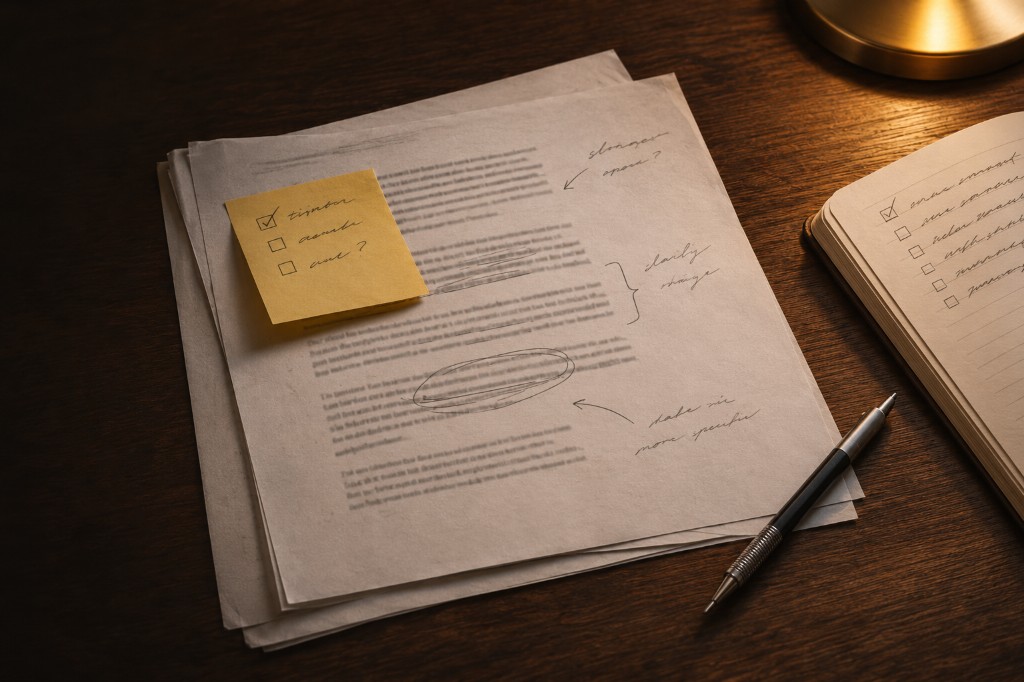
The page
We watch the page, not the screen at full zoom. A chapter title sitting alone at the foot of a page, a single word on the line after it, a blank recto you did not ask for: those get fixed before the PDF is called final. Starting every chapter on a right-hand page adds blanks, and those blanks are real pages. They change the spine.
Running heads carry the author on the left and the title on the right, and they come off the chapter opening and any blank. A header that crashes into the trim is the first thing a proof reader feels with a thumb.
The two files
Agreed with the cover before either file is built. Moving from 5.5×8.5 to 6×9 changes the page count, then the spine. The cover cannot be finished on the old count.
Body text around eleven points, with leading that does not turn the page gray or leave it sparse. One face for the text. A second face is enough for the chapter title.
Single pages, fonts embedded, no crop marks for KDP. Pictures at 300 pixels per inch at the size they print. If art touches the edge, the file includes bleed and the type stays inside the safe area.
Reflowable. Headings are styles, so a phone can change the size. A page number copied from the print file is a print habit. Scene breaks need a mark that still means something when the line lengths change.
What we need
The book
Indented paragraphs, a scene break, a chapter opener with room around it. The header should not shout. The reader is already in the book.
Part, chapter, subhead, in that order, and a contents list that matches the pages. A table has to fit the trim. A slide pasted from a deck usually does not.
The same page as fiction until a photograph or a document shows up. Those need a real resolution and a caption, not a screenshot dropped between two paragraphs.
What we will not set
Formatting a book that is still being rewritten means setting it twice. We would rather wait a week than invoice the same chapter again.
Before the first page
Yes. We rebuild the styles. A file full of tabs, extra returns, and local formatting takes longer, and we will say so before we start rather than discover it on page forty.
It changes the page count, and the page count is the spine. Interior first, wrap second. A cover built on an estimate gets rebuilt when the count moves.
Three hundred pixels per inch at the size they will print. A picture that looks sharp on a laptop can fall apart at trim size. We check that before it is placed, not after the proof arrives.
When you want both. They are quoted as two files because they are two files. A novel that will only live on Kindle still needs styles. It does not need a 6×9 PDF unless you are also printing it.
When the text is settled
If the cover is already drawn, send the page count it was built on. We will say if the interior can hit it. Call (833) 688-4166 or write [email protected].







The shelf
Our team has helped write, publish and market thousands of books over the past decade. Our books are well-written and finished to perfection. Have a look at some of our ghostwriters’ best works and clients’ bestsellers.


Geeks Ghostwriting’s helped me from idea refinement to publishing. I wanted a script on thriller-romance that had multiple twists and turns. I am directing a movie on the story now and our crew has fallen in love with the story!
Having a drama ghostwritten led me to gain the recognition I was seeking. I had an incomplete manuscript and Geeks Ghostwriting helped me complete it. I marketed it and it sold better than I had expected.
I thought that an illustrative self-help book was not possible! As an established designer, I have always wanted struggling designers and students to learn from my mistakes and achievements. The journey that I thought would be arduous turned out to be enjoyable and simple enough. Thank you, Geeks Ghostwriting!
 Chat with an Expert