The read
The whole draft, once, the way a stranger meets it.

Home/Editing/Manuscript Critique
A critique is a diagnosis. We read the manuscript and tell you what the book is trying to be, where it loses that aim, and which problem is worth fixing first. It is not a line edit wearing a longer note.

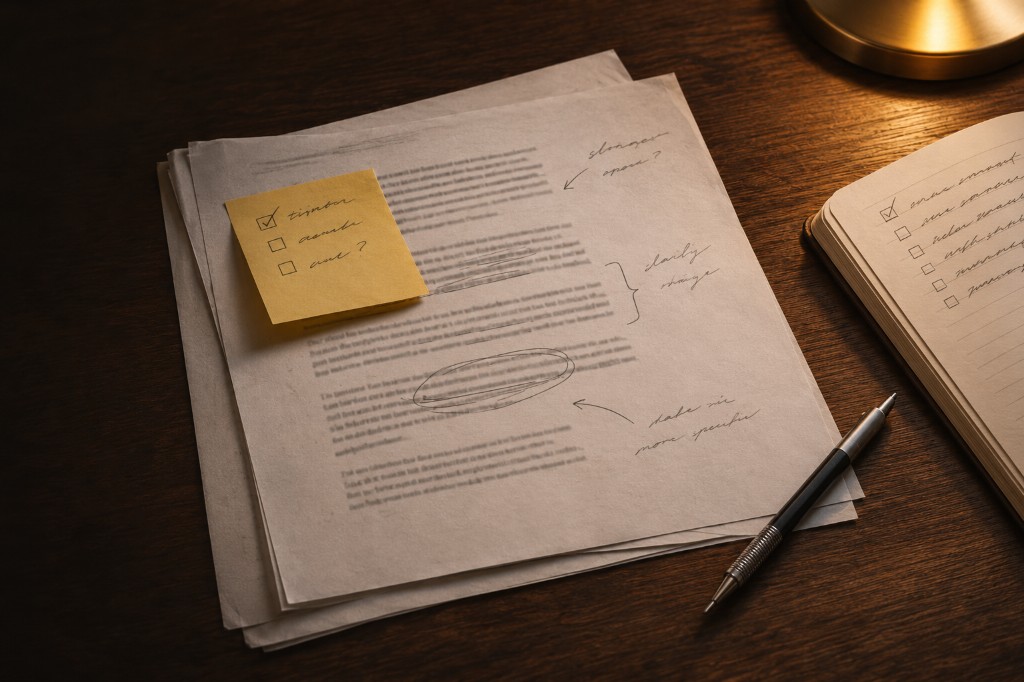
The whole draft, once, the way a stranger meets it.
What the book is, and the breaks that actually matter.
What to fix first, and what can wait.
We do not pretend a letter is a rewrite.

The brief
A useful critique is specific. Not “the middle sags.” Which chapters repeat a point. Which character never wants anything the plot can refuse. Where the promise of the opening is not the promise of the ending. You should be able to disagree, because the claim is clear enough to disagree with.
We do not mark every sentence. That would be a different service and a worse use of a first read. The letter names two or three structural problems and the evidence. If the honest note is that the book is closer than you fear, we say that too, and we say what “closer” still requires.
How the read runs
Once through, without a theory we are trying to prove.
We separate the flaw that changes the book from the ones that only annoy.
Plain language, with the pages that show the point.
Revise it yourself, book a developmental edit, or stop. We will say which.
You push back. A critique that cannot survive a question was too vague.
Before you send the manuscript
A critique tells you what has to change. Developmental editing stays with the book and builds the map you revise from, and can include the conversation that follows. Start with a critique if you want the diagnosis before you commit to a longer job.
Long enough to be specific, short enough to use. Usually a few pages, tied to your chapters. A twenty-page essay about your themes is not more useful than four clear pages.
Yes, if the premise is clear and you know you are stuck. We will not pretend a sample is the whole book. The letter will say what the pages in hand can support.
You do. The letter stays yours. We do not quote your premise in a portfolio.
When you are ready
A full file is best. The chapters where you feel the trouble are enough to start the conversation. Call (833) 688-4166 or write [email protected].







The shelf
Our team has helped write, publish and market thousands of books over the past decade. Our books are well-written and finished to perfection. Have a look at some of our ghostwriters’ best works and clients’ bestsellers.


Geeks Ghostwriting’s helped me from idea refinement to publishing. I wanted a script on thriller-romance that had multiple twists and turns. I am directing a movie on the story now and our crew has fallen in love with the story!
Having a drama ghostwritten led me to gain the recognition I was seeking. I had an incomplete manuscript and Geeks Ghostwriting helped me complete it. I marketed it and it sold better than I had expected.
I thought that an illustrative self-help book was not possible! As an established designer, I have always wanted struggling designers and students to learn from my mistakes and achievements. The journey that I thought would be arduous turned out to be enjoyable and simple enough. Thank you, Geeks Ghostwriting!
 Chat with an Expert