A letter, a ledger, a hearing, a newspaper. Named.


History
A history book has to make an argument a reader can follow, built from sources a careful person could check. Scenes are allowed when the document can bear them. Interior lives you do not have are not a style. They are a fiction, and this shelf is not fiction.
A letter, a ledger, a hearing, a newspaper. Named.
What changed, for whom, and how you know.
What the archive does not say, left as a gap.
Your name on the book. The notes stay with the claims.
Narrative is not a license
The moment a dead person thinks a thought you needed for the paragraph, you have left history.
Readers of this shelf will forgive a strong point of view. They will not forgive a scene that could only have been written by someone in the room when your only source is a census line. We write as close as the record allows: what was said in a hearing, what a letter actually asked, what a newspaper printed and what it refused to print. Weather, clothing, and feeling get in only when a source put them there, or when we mark the sentence as a limit of knowledge. “She must have felt” is the phrase we hunt.
The argument comes early. A history that is only a chronology is a reference, and we can build a reference if that is the job. Most authors want a book someone will read. Then we need the question. Why this strike, this migration, this family, this law. What you think the usual telling gets wrong. Without that, the chapters are a tour, and tours do not tell a reader why the next page is owed.
People who are still alive, and people whose children are, do not become color. A community, a veteran, a political movement: we do not supply motives the papers do not support because the narrative wants a villain or a saint. Disagreement among historians stays visible when it changes the conclusion. Pretending the field is settled when you have chosen a side is a different kind of invention.
When you are ready
A box of notes, a chapter that started to invent a mind, or a claim you can say in one sentence. Call (833) 688-4166 or write [email protected].
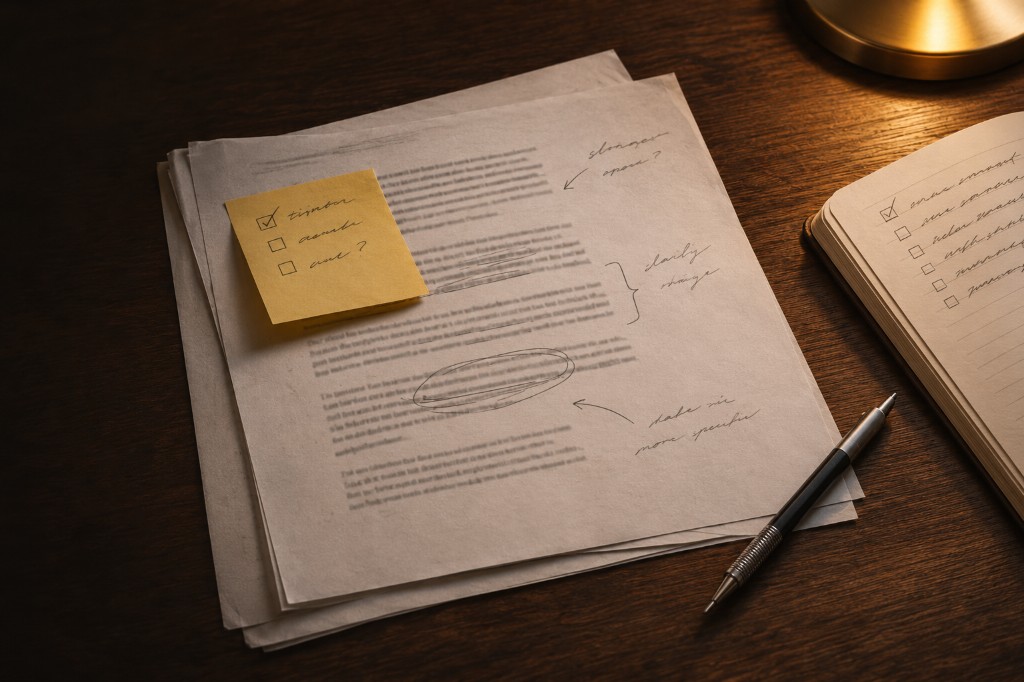
Before the prologue gets cinematic
Archives, interviews, a literature you can name. A fascination is not a source base. If the book is still a stack of other people’s popular books, we are summarizing, and we should call it that or stop.
One sentence a specialist could argue with. If you cannot stand the argument yet, we are not ready to write chapter one. Research can continue. Prose should not pretend.
A private room, a victim, a mind. Write the refusals. They keep the draft from becoming a novel in the third month, which is when the scenes get tempting.
Order of the work
Beautiful paragraphs are hard to take back once you love them. The note is cheaper.
Dates, actors, and the source for each load-bearing fact. Conflicts between sources stay on the page of the working file.
What would falsify it. Which source you have not seen. We would rather a narrower claim than a grand one with a hole in the middle chapter.
Dialogue from the record, attributed. Action from a witness who was there. Everything else is summary, and summary is an honorable mode.
Before polish, we check that a reader can find the basis of every striking claim. Endnotes are part of the book, not an apology added after the prose has floated free.
We will not add
If it is not in a document or an interview, it is not in quotation marks, and it is not paraphrased into a scene we cannot source.
Grief, courage, and doubt are real and often unrecorded. We do not loan them to a person because the chapter feels cold.
People in the past can be judged. They cannot be given our vocabulary so the ending feels current.
Oral history is evidence, with a date and a stake. It is not a key that opens every locked room.
Questions worth asking first
Yes. Sequence, character, and consequence are how readers stay. The constraint is the source, not the dullness. The best narrative history is often plainer than the cinematic kind, because it does not have to inflate. If you want invented interiors, that is historical fiction, and we should build that book instead of blurring the label.
We can organize, question, and write from a research base you have or that a researcher builds under a plan we agree. We will not imply we sat in an archive we did not visit, and we will not invent a document to fill a gap. Gaps are allowed to remain gaps.
They can be history if the evidence is treated as evidence: letters, deeds, newspapers, interviews with the living done carefully. A family legend is a source about what the family needed to believe. It is not automatically what happened. We can write both, if the book is honest about the difference.
You do. The copyright in the prose is yours. The underlying facts are not property, but your selection, interviews, and wording are. We do not shop your archive or your argument as a sample. If living people are portrayed, their dignity is part of the job, not a later legal surprise.






The shelf
Our team has helped write, publish and market thousands of books over the past decade. Our books are well-written and finished to perfection. Have a look at some of our ghostwriters’ best works and clients’ bestsellers.


Geeks Ghostwriting’s helped me from idea refinement to publishing. I wanted a script on thriller-romance that had multiple twists and turns. I am directing a movie on the story now and our crew has fallen in love with the story!
Having a drama ghostwritten led me to gain the recognition I was seeking. I had an incomplete manuscript and Geeks Ghostwriting helped me complete it. I marketed it and it sold better than I had expected.
I thought that an illustrative self-help book was not possible! As an established designer, I have always wanted struggling designers and students to learn from my mistakes and achievements. The journey that I thought would be arduous turned out to be enjoyable and simple enough. Thank you, Geeks Ghostwriting!