What the words refuse to say, so the picture can.


Picture Books
A picture book is a read-aloud with a turn. The text leaves work for the image. If every page needs a paragraph, it is not a picture book yet. It is a story that has not decided what the child will see.
What the words refuse to say, so the picture can.
The page that makes the repeated line mean something else.
A text an adult can read without stumbling, twice a night.
The listener is part of the timing. Leave them a place to point.
The form, counted
If the text describes the picture you hope an artist will draw, you have written the art out of a job.
Most picture books that work in print are thirty-two pages, including the matters a writer forgets: title, copyright, a dedication if you insist. That leaves roughly fourteen spreads for the story. We paginate early, in a dummy, because a joke that needs three sentences will not survive a spread, and a turn that arrives on the wrong page will be felt as a stumble in the lap. The form is small and unforgiving. That is why it is not a shorter children’s chapter.
Text and image split the sentence. Words can carry sound, a repeated pattern, and the thing a picture should not spoil too soon. Pictures carry expression, setting, and the joke the words pretend not to notice. We write less than the draft wants. “She was sad” is almost always wrong, because sadness is a face, and the line should be what she says or the sound of the door. Read-aloud also means rhythm. A parent will be performing this while someone interrupts. The line has to be easy to find again.
We do not illustrate. If you have an artist, we write to leave them decisions, and we will revise once we see what they drew, because a good picture will make some of our lines redundant. If you do not have an artist, the manuscript still has to read as a sequence of pages, with notes only where the irony depends on a contradiction between word and image. A novel with “illustration here” in the margins is not a picture book.
When you are ready
A draft, a refrain, or a story you keep explaining instead of reading. Call (833) 688-4166 or write [email protected].
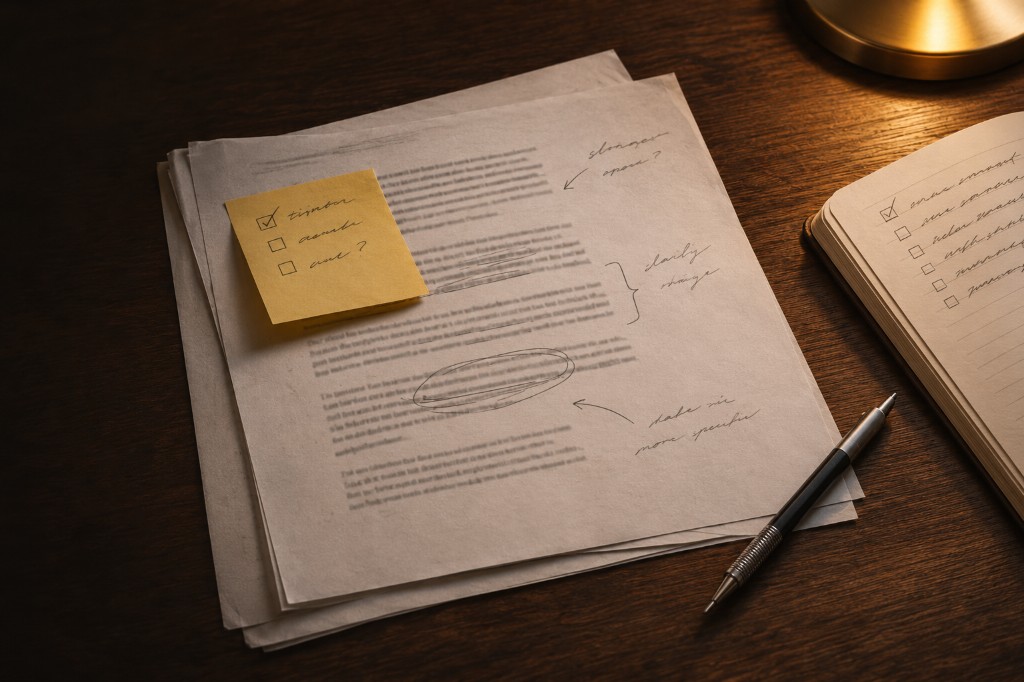
Before anyone draws
Two, four, and six are different listeners. A book for a toddler can repeat and be physical. A book for a child who already tells jokes can hide the punch on the right-hand page. Pick the lap.
A repeated line, action, or question, and the one time it breaks. Without a pattern, thirty-two pages feel long. Without a break, they feel like a list.
The thing the child should notice in the picture first. If you cannot name it, the text is probably doing the picture’s work, and the artist will have nothing to add but decoration.
Order of the work
A beautiful paragraph that does not know its spread will be cut anyway. Better to know the spread.
Fourteen spreads, one job each. We write the turn on the spread where the hand has to turn the page to get it. Suspense in a picture book is physical.
Read aloud, including the sounds. We remove adjectives the picture will own, and we remove any sentence an adult has to explain before the child can laugh or worry.
A refrain, a sound, a question. Not on every page like a trick, but enough that the reading is shared. A book that only performs at the child gets old on night three, and night three is the real test.
The last spread should still be doing visual work. A moral printed under a smiling face is the ending we delete. If the story was about a hat, the last page is the hat, changed.
We will not send these to an artist
If the story needs that many words, it is a chapter book or it has not been cut. We will not shrink the font in our minds and call it a picture book.
Sharing, bravery, and kindness can be the event. The moment someone says the lesson, the child has been dismissed from the work of seeing it.
Stage directions that describe the joke are how writers keep control they need to hand over. We cut them once the page can carry the joke without them.
If the adult must explain the ending, it is not a picture-book ending. Cleverness that only the parent enjoys is a different, worse book hiding in the good one.
Questions worth asking first
No. We write the text and a light pagination. Hiring an artist, and the contract with that artist, is a separate matter you should put in writing with them. We can revise the words after sketches exist, which is often when the real cuts appear. We will not draw the book, and we will not describe ourselves as having done so.
Often under five hundred, sometimes under two hundred, and the number is not the art. A concept book can be very few words. A story with a real turn usually needs enough language to make the pattern audible. We cut to the pattern. We do not cut to hit a rumor about what agents prefer, unless you are actually aiming at a guideline you have shown us.
Yes, if you want rhyme enough to let it change the sentence. Bad rhyme is harder to read aloud than plain prose, because the adult can hear the cheat. We would rather break a scheme than force a word the story did not want. If the book is funnier in prose, we will say so and leave the rhyme.
You do. The copyright in the manuscript is yours, including lines drafted here. The pictures, once they exist, belong to the artist unless your agreement says otherwise. We do not claim either, and we do not circulate your dummy as a sample.






The shelf
Our team has helped write, publish and market thousands of books over the past decade. Our books are well-written and finished to perfection. Have a look at some of our ghostwriters’ best works and clients’ bestsellers.


Geeks Ghostwriting’s helped me from idea refinement to publishing. I wanted a script on thriller-romance that had multiple twists and turns. I am directing a movie on the story now and our crew has fallen in love with the story!
Having a drama ghostwritten led me to gain the recognition I was seeking. I had an incomplete manuscript and Geeks Ghostwriting helped me complete it. I marketed it and it sold better than I had expected.
I thought that an illustrative self-help book was not possible! As an established designer, I have always wanted struggling designers and students to learn from my mistakes and achievements. The journey that I thought would be arduous turned out to be enjoyable and simple enough. Thank you, Geeks Ghostwriting!