A turn lives in the page break, not only in the dialogue.


Graphic Novels
A graphic novel script is a timing document. The page is a unit of time, the panel is a cut, and silence is a tool. We write what an artist needs in order to draw the story, not a prose novel that mentions panels in passing.
A turn lives in the page break, not only in the dialogue.
What the drawing is doing that words must not narrate.
Speech as speech. No one talks in paragraphs unless the joke is that they do.
Your name on the book. The script stays yours.
What the script is responsible for
A panel description that says “she looks sad” has handed the artist a mood and withheld the story.
Comics fail in a specific, expensive way: the words and the pictures do the same job. A caption tells us he is nervous while the picture shows him nervous, or a balloon explains a clue the image already put in the reader’s hand. We write for the division of labor. Action and setting that can be drawn are not narrated. Words carry what a picture cannot: a lie, a private name, a time jump the image would make ambiguous, a joke that depends on what is not said.
The page, not the panel, is the sentence we plan first. How many beats before the turn. What the reader’s eye owes the last panel, because that is the pause before the hand moves. A talky scene can be two panels if the positions change the power. A silent page can be the plot, if we have earned what the silence is refusing to say. We do not write “a montage of the city” and leave the artist to invent the book.
You may already have an artist, or you may need the script to be legible to one you have not met. We write a form a collaborator can use: page, panel, what is visible, what is said, what is deliberately not shown. We do not pretend to be the penciller. If you want us to art-direct a style you have references for, bring the references. “Cinematic” is not a note. A frame from a book you love is.
When you are ready
A premise, a prose draft, or eight pages that already break. Call (833) 688-4166 or write [email protected].
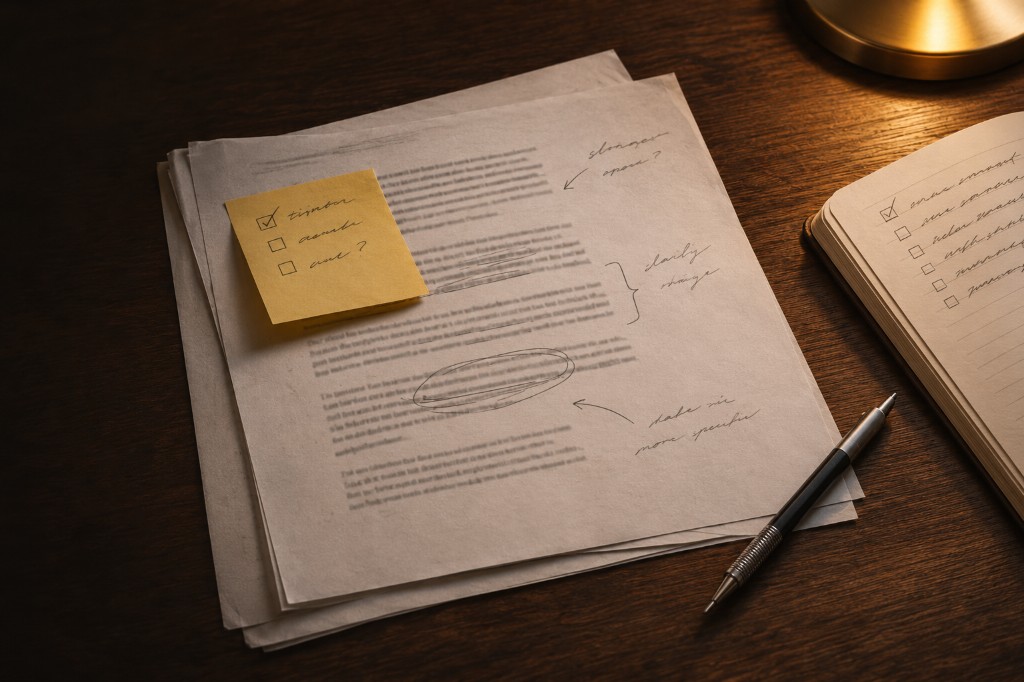
Before page one of the script
Page count, and whether this is a single book, a serialized chapter, or a pitch of eight pages plus an outline. A 120-page graphic novel and a 22-page short are different machines. We will not write one and call it the other.
If an artist is attached, we write to their strengths and to the number of backgrounds they can actually live in. If no artist is attached, the script has to carry the story without relying on a miracle of draftsmanship you do not have yet.
Some stories need an interior the picture should not illustrate directly. Say so. The script can keep a thought in caption, or it can stage an action that implies it. Those are different books.
Order of the work
Pretty balloons on a broken page are the most costly kind of revision, because the artist will have drawn them.
One line per page: the turn that page is for. We do this before panel counts. If a page has no turn, it is probably a stall or a poster, and we cut it while cutting is still cheap.
What must be visible, what must be silent, where the balloon is a contradiction of the face. Not a camera script so detailed that the artist cannot draw. Enough that two readers of the script would stage the same story.
Read aloud. Comics dialogue that looks fine in a document often dies in a balloon because it was written as prose. We cut to the line a person would spend the ink on.
Last, we check that no essential fact lives only in a caption a reader could skip, and that no joke depends on a detail too small to survive print. The ending has to work in the pictures even if someone is reading fast, because many readers will.
We will not hand an artist
Paragraphs of interior life with “panel” written above them are not a comic. We rewrite until the page is a sequence.
If the picture will show the door closing, the caption does not say the door closed. It says the thing the door is lying about, or it says nothing.
A battle, a party, or a citywide panic is not a plot. Someone still has to decide, in a panel we can understand at print size.
We will not write a double-page metamorphosis on every spread and leave the practical book for later. The spectacular moment is earned by how rarely the script spends it.
Questions worth asking first
No. We write the script and, if you want, the page map a collaborator can draw from. If you already have an artist, we can work to their format and revise against their thumbs. We will not pretend that a written description is a finished graphic novel. The book is finished when the pages exist.
A clear page-and-panel script unless you and your artist share a different house style. We are not loyal to a film template. We are loyal to whether an artist can tell what must be seen. If you have sample pages from the person who will draw it, send those. Matching their rhythm matters more than matching a manual.
Yes, if you are willing to lose scenes. Adaptation is a set of cuts and a few inventions that only comics can do: a silent page, a repeated panel, a balloon that contradicts a face. We will not transcribe chapters into boxes. Tell us the one plot the graphic novel is actually about. The prose book is allowed to have been about more.
You do. The copyright in the script written here is yours. Art, if someone else draws it, is a separate right you need to agree in writing with that person. We do not claim the pages, and we do not show your script as a sample that identifies the story.






The shelf
Our team has helped write, publish and market thousands of books over the past decade. Our books are well-written and finished to perfection. Have a look at some of our ghostwriters’ best works and clients’ bestsellers.


Geeks Ghostwriting’s helped me from idea refinement to publishing. I wanted a script on thriller-romance that had multiple twists and turns. I am directing a movie on the story now and our crew has fallen in love with the story!
Having a drama ghostwritten led me to gain the recognition I was seeking. I had an incomplete manuscript and Geeks Ghostwriting helped me complete it. I marketed it and it sold better than I had expected.
I thought that an illustrative self-help book was not possible! As an established designer, I have always wanted struggling designers and students to learn from my mistakes and achievements. The journey that I thought would be arduous turned out to be enjoyable and simple enough. Thank you, Geeks Ghostwriting!