The brief
Which context, which chapters, and what you are worried you got wrong.

Home/Editing/Sensitivity Reading
A sensitivity read looks at a specific lived context in the manuscript: what the scene is saying, where it is inaccurate, and where a reader from that context would be used as a prop. It is not a pass-fail stamp on the whole book.

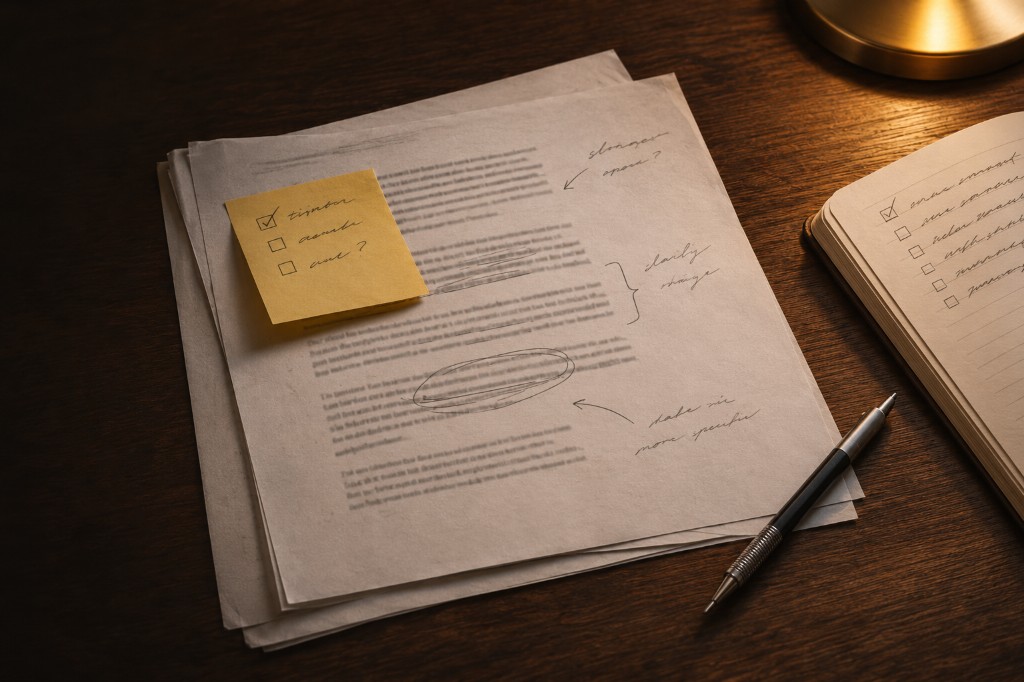
Which context, which chapters, and what you are worried you got wrong.
A stereotype doing the work of a character, named in the scene.
A change that keeps your plot and drops the false note.
We do not pretend one reader speaks for everyone.

The brief
The useful version of this work is narrow. You tell us the context: a disability, a faith, a language, a city, a body of experience that is not yours. A reader with standing in that context reads the relevant pages and writes what is inaccurate, what is a cliché doing the work of characterization, and what a person from that life would find unrecognizable.
We separate harm from discomfort. A book is allowed to be harsh. It is not improved by a false detail that makes a group into a device. The note suggests a fix where there is a fix. Where the problem is the premise itself, we say that, and you decide whether the book can survive the change.
How the read runs
What you need read, and why you suspect it. Vague worry is not a brief.
Standing in the context, not a general editor guessing.
The chapters that carry the material, read in the book’s own terms.
What is wrong, why, and what could stand there instead.
You revise, you keep, or you ask for a conversation. We do not take the byline.
Before you send the manuscript
No. No honest reader can. We can tell you what a knowledgeable reader sees, and where the page is inaccurate or lazy. “Offend no one” is not a standard a book can meet, and we will not sell it.
Only if they have both kinds of standing. Usually they should be different people. An editor who is good at structure is not automatically the right reader for a life they have not lived.
Then it is more than one read. We will not ask one person to speak for every identity that passes through the book.
You do. We do not publish your pages or the reader’s comments.
When you are ready
Name what you think you may have gotten wrong. That is the brief. Call (833) 688-4166 or write [email protected].







The shelf
Our team has helped write, publish and market thousands of books over the past decade. Our books are well-written and finished to perfection. Have a look at some of our ghostwriters’ best works and clients’ bestsellers.


Geeks Ghostwriting’s helped me from idea refinement to publishing. I wanted a script on thriller-romance that had multiple twists and turns. I am directing a movie on the story now and our crew has fallen in love with the story!
Having a drama ghostwritten led me to gain the recognition I was seeking. I had an incomplete manuscript and Geeks Ghostwriting helped me complete it. I marketed it and it sold better than I had expected.
I thought that an illustrative self-help book was not possible! As an established designer, I have always wanted struggling designers and students to learn from my mistakes and achievements. The journey that I thought would be arduous turned out to be enjoyable and simple enough. Thank you, Geeks Ghostwriting!
 Chat with an Expert