What this person cannot legally, socially, or physically do.


Historical Fiction
Historical fiction is not a modern novel in a waistcoat. It is a story in which the things a person cannot say, buy, leave, or survive are specific to that place and that decade. The research is the floor. It is not the book.
What this person cannot legally, socially, or physically do.
What is in the record, and what we are inventing beside it.
A voice that could have existed, not a lecture in period dress.
Your name on the book. The research trail stays with you.
Where these manuscripts go wrong
If a person from the decade would pause the conversation to explain their own tools, the sentence is for us. Cut it.
The common failure is a tour. Correct candles, correct battles, correct cloth, and a narrator who thinks like a person who has read the history of their own year. People inside a time do not narrate it. They complain about a price, avoid a neighbor, lie to a priest, wait on a letter, do a job until their hands change. We write that day. The year arrives because the day cannot be moved.
Dialogue is the tell. Museum speech gives itself away in explanations: what a war means, what a class is called, how a machine works to someone who uses it every morning. We allow a person to be witty, cruel, devout, or crude in the ways their station made possible. We do not give them our hindsight, and we do not sand them into modern manners so the book will feel comfortable at a book club. Comfort can be earned by clarity. It should not be bought by cheating the mind.
Invention has to be labeled in the working notes even when it is seamless on the page. A real regiment, a real house, a real public figure: we do not put private words in their mouths without a source, and we do not hang a plot on a public fact we have not checked. Composite streets are allowed. A fake law that changes the moral math of the book is not, unless the book declares itself a fable and we build it as one.
When you are ready
A date, a job, and the thing they were not allowed to do. That is a start. Call (833) 688-4166 or write [email protected].
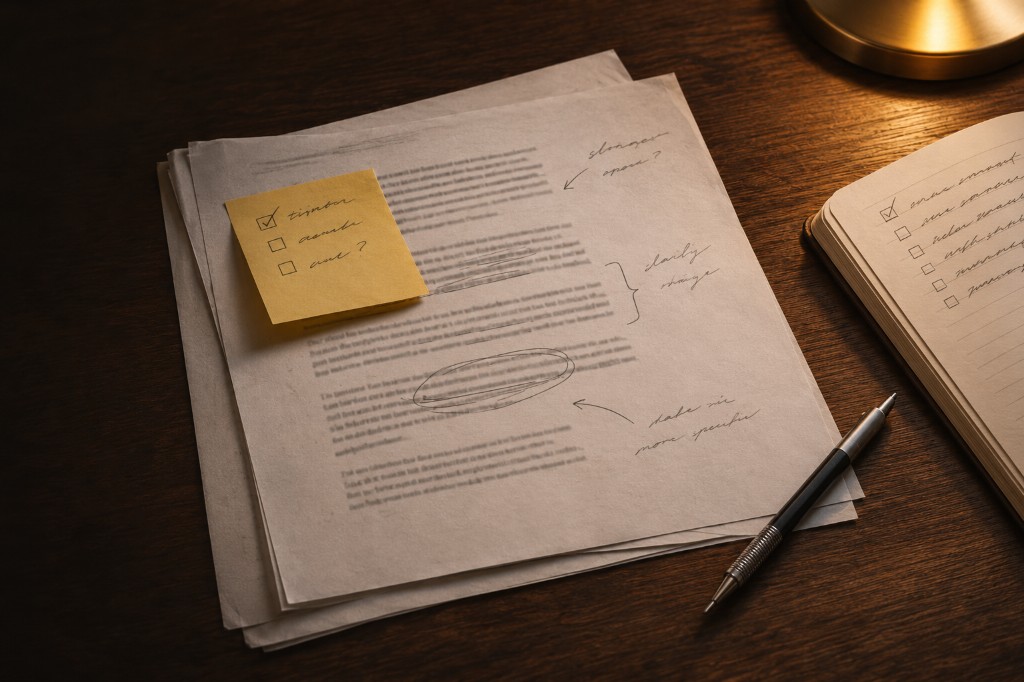
Before the bibliography becomes the draft
What they do for the hours that are not the famous event. A kitchen, a dock, a parish, a mill, a camp. If the book is only the famous event, it is an illustration.
The permission they lack: travel, marriage, credit, speech, safety after dark. The plot should have to negotiate that door instead of forgetting it when the scene would be better without it.
Name the public facts that are fixed. We would rather have a short list and keep it than discover in revision that the battle was a year off and the inheritance never worked that way.
Order of the work
Research continues beside the draft. It does not get to replace the draft, and the draft does not get to outrun the record.
A few pages of ordinary work and speech. If you can change the date in the header and leave the scene, the scene is not historical yet. We keep rewriting until the limit is in the verbs.
For each load-bearing fact: where it came from, and whether a living specialist would flinch. Gaps are marked in the notes, not papered with confident prose.
The marriage, the debt, the faith, the ambition, set where the larger history actually pinches. We do not pause the life for a chapter of context.
We mark every sentence that knows the future, explains a custom to its own user, or makes a person of the time unusually modern so we will like them. Some of those sentences can stay, if the book is honest that this mind was strange. Most of them go.
Not in the manuscript
If it teaches the reader the period, it is probably not a person talking. We move the fact into an inconvenience.
A character may dissent from their time. They have to dissent with the words, risks, and concepts they could have had. Our politics, pasted on, read as a wink.
A real person can cross the page. They should not deliver the theme, the clue, or the moral unless the record gives you that meeting.
Courtship had witnesses, money, faith, and law in it. A secret that would have ruined them has to be written as a secret that could ruin them, or it is a contemporary romance in a dress.
Questions worth asking first
Accurate where a knowledgeable reader can check, and honest where we invent. Daily life, law, money, and public events that the plot relies on get verified. Interior life is imagined, and it should still be possible. We will tell you when a beloved scene depends on a fact that will not hold, and we would rather lose the scene than keep a footnote pretending to save it.
Yes, if you have the right to the private material, or the people are far enough into the public record that we are not inventing the grief of the living. Family stories collect wishes. We separate what an aunt remembers, what a letter says, and what the novel needs. Those three are not the same sentence.
Clarity is not the same as updating the mind. We avoid glossary dialogue. We also avoid slang so thick the book becomes a performance. A reader should be able to follow the want in the scene without a degree. They do not need the characters to think like the reader.
You do. The copyright is yours, including chapters drafted here and the decisions about what is history and what is invention. We do not retell your research as a case study. The archive, if it is yours, stays yours.






The shelf
Our team has helped write, publish and market thousands of books over the past decade. Our books are well-written and finished to perfection. Have a look at some of our ghostwriters’ best works and clients’ bestsellers.


Geeks Ghostwriting’s helped me from idea refinement to publishing. I wanted a script on thriller-romance that had multiple twists and turns. I am directing a movie on the story now and our crew has fallen in love with the story!
Having a drama ghostwritten led me to gain the recognition I was seeking. I had an incomplete manuscript and Geeks Ghostwriting helped me complete it. I marketed it and it sold better than I had expected.
I thought that an illustrative self-help book was not possible! As an established designer, I have always wanted struggling designers and students to learn from my mistakes and achievements. The journey that I thought would be arduous turned out to be enjoyable and simple enough. Thank you, Geeks Ghostwriting!