A city, a road, a season. Narrow enough to be true.


Travel
A travel book has to know a place on a weekday: what it costs, who is working, what a visitor gets wrong, and what a resident wishes you would stop repeating. Awe is allowed. Awe as the only research is how books become brochures.
A city, a road, a season. Narrow enough to be true.
Errands, meals, transit, a price with a year on it.
Who lives there when you leave. Not a backdrop.
Your name on the book. Theirs stays credited.
The trip versus the book
If a local would laugh by page ten, the page is about you. Cut it or earn it.
We ask how long you stayed and what you were doing besides looking. A weekend can support an essay. It cannot support a book that explains a city. A season of work, a family visit, a reporting trip with interviews, a walk you repeated until it got ordinary: those can. The ordinary is the point. What people eat when nobody is photographing them. What the bus costs. Which neighborhood advice is a decade out of date. We would rather a short book that is current and humble than a long one that treats a place as a feeling you had.
The people who live there are not color for your interior life. If someone fed you, drove you, or told you a story, the book should not be surprised that they have a stake in how they appear. We get permission where a portrait is specific, and we do not invent a wise local to deliver the theme. That figure is a colonial habit that survived into otherwise modern prose. It reads as such.
Practical detail has an ethics too. A secret beach that cannot hold the crowd your book will send. A restaurant too small for the recommendation. A ritual you were not invited to describe. We talk about what the book will do to the place, not only what the place did for your chapter. Sometimes the right sentence is a refusal to print the directions.
When you are ready
Notes, a route, or a chapter that is mostly a sunset. Call (833) 688-4166 or write [email protected].
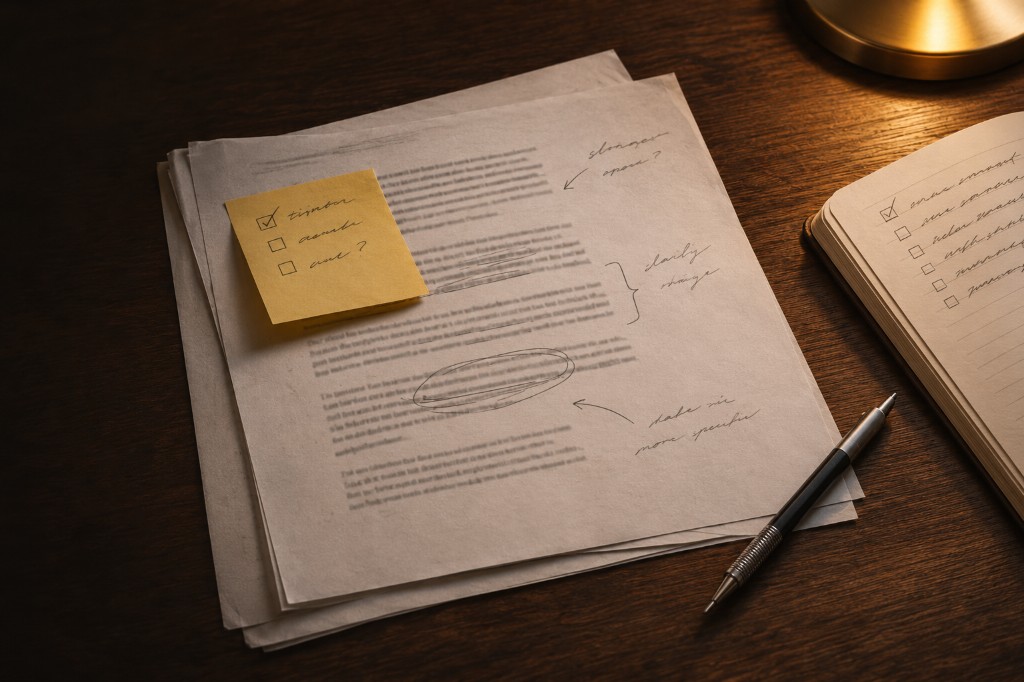
Before the itinerary
Work, family, reporting, a childhood, a move. “I went” is a start. It is not a claim on the reader’s attention.
A year, a price, a closure. Travel facts rot. The book should say when you knew them, and what a reader must recheck.
A home, a sacred site, a person’s immigration status, a fragile spot. The glamour of access is not a reason.
Order of the work
The view is what everyone already has. The day is what you might actually know.
A question, a route with a reason, a job, a meal repeated. If the table of contents is only neighborhoods, we do not have a book yet.
Interviews or a clear decision that this is a personal essay and will not pretend to be a portrait of a people. We do not blur those modes in one lyrical paragraph.
How to arrive, what it costs, what changed. Separated from the mood so a reader can use them or ignore them. Mood should not be asked to carry a bus schedule.
We mark every sentence that uses a person as scenery or a struggle as spice. Those sentences get replaced with something you are willing to say in the room.
We will not export
Sunsets, “chaos,” “magic.” If the noun could be any city, it is not observation.
The best meal, ranked, with no sense of the street it sits on. Lists without judgment about scale are how places get wrecked.
A family argument, a worker’s complaint, printed because it was vivid. Access is not consent.
One city, one trip, offered as the nation. We narrow the claim until it fits the days you had.
Questions worth asking first
Yes, if the facts are checked, dated, and useful, and if we agree who is updating them. A guidebook that is really an essay will frustrate the reader who needed the hour a museum closes. An essay that is really a guidebook will bore the reader who came for a mind. Tell us which promise is on the cover.
No. We write from your notes, interviews, and reporting. We will not invent a street we have not been shown carefully enough to describe without lying. If a gap requires another visit, we say so. We do not fill it with atmosphere.
Allowed, when it is specific and you have stayed long enough to know the thing you are criticizing. A complaint about inconvenience is not insight. A reported fact about labor, policy, or a scam aimed at visitors can be. We will ask whether you would publish it under your name in that city. If the answer is no, it does not belong.
You do. The copyright is yours, including chapters drafted here. Photographs, interviews, and a host’s story are separate rights. We do not reuse a place or a person you introduced us to as a sample.






The shelf
Our team has helped write, publish and market thousands of books over the past decade. Our books are well-written and finished to perfection. Have a look at some of our ghostwriters’ best works and clients’ bestsellers.


Geeks Ghostwriting’s helped me from idea refinement to publishing. I wanted a script on thriller-romance that had multiple twists and turns. I am directing a movie on the story now and our crew has fallen in love with the story!
Having a drama ghostwritten led me to gain the recognition I was seeking. I had an incomplete manuscript and Geeks Ghostwriting helped me complete it. I marketed it and it sold better than I had expected.
I thought that an illustrative self-help book was not possible! As an established designer, I have always wanted struggling designers and students to learn from my mistakes and achievements. The journey that I thought would be arduous turned out to be enjoyable and simple enough. Thank you, Geeks Ghostwriting!