How a person eats, works, and is counted.


Dystopian
Dystopian fiction fails when it tours the cruelty and never sits with one person who has to get bread, keep a job, or decide what to tell a child. The system has to interrupt a day. Otherwise it is a poster with chapters.
How a person eats, works, and is counted.
Who reports, and what a small obedience costs.
The private life the rule is trying to enter.
Your name on the book. The desk stays off it.
What the shelf is for
If the regime can be described in adjectives and never in a form, a queue, or a fine, the novel has not started.
Readers have seen the gray city, the slogan, the rebel with a jaw. What they have not automatically seen is your rule: the specific way this society gets compliance on a weekday. A permit. A neighbor with a quota of reports. A school that asks children to correct their parents’ meals. A clinic that trades care for a statement. The book becomes itself in that mechanism, not in the speech about it.
We start from scarcity and paperwork because those are how people actually meet a state. A protagonist who is already the symbol of the resistance, with no shift to miss and no one at home to endanger, is a mascot. Give us the person who wanted a smaller life and got chosen by a rule. The plot is what they do when the smaller life is no longer available.
Hope, if you want it, has to be a choice with a price. A last-chapter speech about the human spirit is not an ending. An ending is a forged stamp, a refused name, a child moved to a different queue, a record altered at a cost the earlier chapters made legible. We will not glue courage on after the tour.
When you are ready
A form, a household, or a stalled chapter is enough. Call (833) 688-4166 or write [email protected].
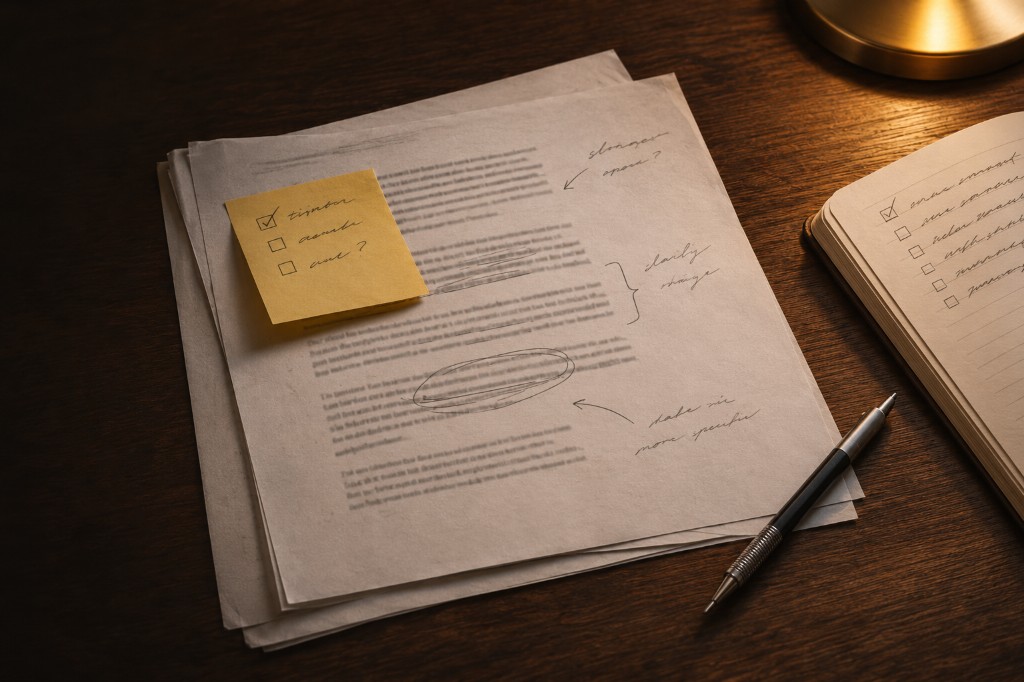
Before the worldbuilding folder
The document, ritual, or count a person cannot skip. If you cannot describe the moment of compliance, the politics are still a mood.
Not the distant tyrant. The floor manager, the popular teacher, the cousin who gets a better ration for staying quiet. Systems are held up by people with small wins.
Who in the house pays if the protagonist is brave too early. Dystopias go thin when courage is free. Name the person who did not volunteer for the symbol.
Order of the work
A resistance with no ordinary day underneath it is a costume change. The day comes first.
We draft the morning the rule works and nobody is heroic. What they eat, what they sign, what they pretend not to see. If that morning is not interesting, the later defiance will be a speech.
Who can help, who must report, who can lose a job by knowing the wrong fact. The plot moves through those permissions. It does not jump to the tower because the tower is more dramatic.
The first refusal should be small enough to be plausible and expensive enough to matter. We price it before we write the chase.
The last pages show what the choice changed in the ration, the household, or the record. If the world is identical except for a hopeful sentence, we are not finished.
We will not print these
Flying over the misery is not a chapter. A chapter is a counter, a waiting room, a dormitory check.
If the idea needs a speech, it is not yet a scene. We put the idea in a choice that inconveniences someone.
Food, traitors, and sleep. A cell that never argues about those is a poster.
We will not invent a punishment because the tone feels soft. If the rule does not need it, it is spectacle, and spectacle makes the real harm harder to believe.
Questions worth asking first
It overlaps, and it is not owned by the gadget. Science fiction owes a consequence that follows from an idea. A dystopia owes a social procedure a person cannot politely step around. You can have both. If the book is mostly a tour of technology, we should say so and build that book instead of pretending the regime is the subject.
No. People joke, flirt, cook, and waste time inside bad systems. That is part of the truth. What it cannot do is forget the procedure for three chapters because the romance, or the heist, got more fun. The system should be able to reach into the best scene and make it cost something.
Yes, and then the research standard goes up. We will not invent a law, a police power, or a public fact and file it under fiction if a reader could mistake it for the record. Invented regimes get a clear invented logic. Near-future books get their real-world pieces checked.
You do. The copyright stays with you, including the world and the chapters drafted here. We do not shop your regime as a premise we can describe to someone else. If you want that stated before any pages move, say so on the first call.






The shelf
Our team has helped write, publish and market thousands of books over the past decade. Our books are well-written and finished to perfection. Have a look at some of our ghostwriters’ best works and clients’ bestsellers.


Geeks Ghostwriting’s helped me from idea refinement to publishing. I wanted a script on thriller-romance that had multiple twists and turns. I am directing a movie on the story now and our crew has fallen in love with the story!
Having a drama ghostwritten led me to gain the recognition I was seeking. I had an incomplete manuscript and Geeks Ghostwriting helped me complete it. I marketed it and it sold better than I had expected.
I thought that an illustrative self-help book was not possible! As an established designer, I have always wanted struggling designers and students to learn from my mistakes and achievements. The journey that I thought would be arduous turned out to be enjoyable and simple enough. Thank you, Geeks Ghostwriting!