One want, one room, one thing that can break.


Short Stories
A short story has room for one pressure and the moment it changes. It is not a novel that ran out of time, and it is not an anecdote with a moral taped on. The last paragraph has to make the first one mean something else.
One want, one room, one thing that can break.
The ending revises the opening. It does not explain it.
A collection needs a reason these pieces sit together.
Your name on the work. The pieces stay yours.
What the length is for
A story that ends by telling you what it meant has usually failed to do the thing it is now describing.
Short fiction is ruthless about attention. A reader will give you ten pages, sometimes twenty, and they will feel a digression as a broken promise. We choose the pressure that can be fully present: a resignation letter that is not sent, a visit that has already gone on too long, a child waiting in a car while an adult lies inside. The world can be large. The story’s job is small and exact. If you need the whole marriage, you may need a novel, and we will say so before we inflate a story with backstory.
Endings are where drafts confess. A summary, a twist that depends on information never offered, or a lyrical paragraph that floats free of the want: those are exits, not endings. We look for the turn that was latent in the opening image. The cup, the uniform, the polite sentence, reused once the terms have changed. The reader should be able to return to paragraph one and find it altered without our help.
A collection is not a folder. Stories can argue with each other, share a town, or hold one question at different temperatures. What they cannot be is leftover chapters and exercises bound because the page count looked thin. We will help you see which pieces belong, which are drafts of the same story, and which should stay in the drawer without being called failures. Leaving a story out is part of making a book.
When you are ready
A scene, a failed last page, or a pile that might be a book. Call (833) 688-4166 or write [email protected].
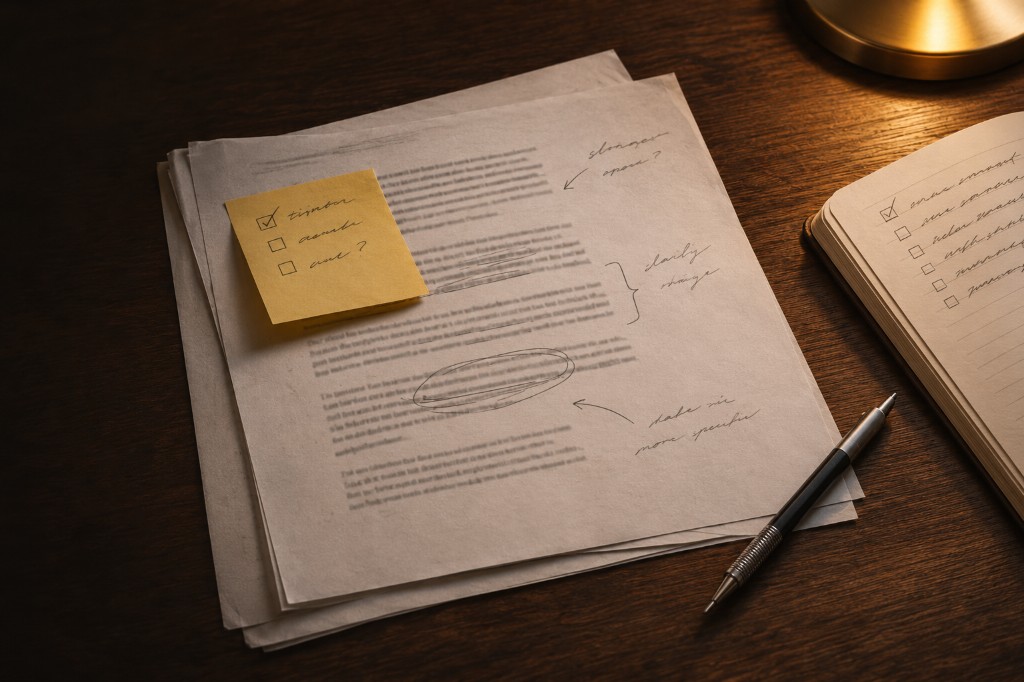
Before we add a second plot
What is different in the room, the mind, or the power between people by the last line. If the answer is a mood, we do not have an ending. We have an atmosphere.
Stories often start too early. Name the hour in which the pressure is already active. Arrival, backstory, and “a typical day” can usually be cut to a clause.
If this is for a collection, say what question the other stories are already asking. A brilliant outlier can still make the book feel like a miscellany.
Order of the work
Beautiful openings are easy to overvalue. The turn decides whether the opening was doing work.
Not a theme. An event or a recognition: she sends it, he does not knock, the child repeats the lie correctly. We keep that sentence where we can see it while the rest is written.
Every additional character has to push the pressure. A colorful friend who demonstrates the theme is usually the first cut.
We write through, then remove the sentence that explains the turn. If the story dies without that sentence, the turn is not yet in the action.
Sequence is an argument. We read the stories in more than one order before locking a table of contents. The first story teaches the reader what kind of attention you want. The last one should not repeat the lesson in a larger font.
Cut in revision
A childhood, a war, or a previous marriage gets a place only if the present scene cannot be understood without a specific fact. Even then, it is usually a paragraph, not a section.
We will not tell the reader what the image meant. If we are tempted, the image is not finished or it is the wrong image.
Surprise is not permission. The fact that rearranges the story has to have been visible as something else.
In a collection, we will notice if every story ends on a quiet sadness about modern life. Repetition of move is not a style. It is a stall.
Questions worth asking first
As long as the turn needs, and no longer. Many finished stories land between roughly 2,000 and 7,000 words. Some need 10,000. Past that, we ask whether you have a novella, which is a different shape, with a middle that must do more than delay. We will not pad a story to look serious, and we will not amputate a real middle so it fits a contest limit unless you are actually sending it to that contest.
If the fragments are scenes with people in them, yes. If they are ideas, quotes, and notes toward a feeling, we still need the pressure of each piece. We can help you find it. We cannot assemble a book out of prompts and call it a collection. Bring the pages you are willing to see cut.
We can write toward a length and a heat you have actually seen in a specific journal, if you show us the issues, not a rumor about them. We will not sand your sentence into a generic “literary” quiet, and we will not add a twist because someone said markets want one. The turn still has to belong to the people on the page.
You do. Each story and the arrangement of a collection stay in your copyright, including drafts written here. We do not submit, post, or describe your pieces in a way that identifies them. If a story is close to a living family, say so before we sharpen it.






The shelf
Our team has helped write, publish and market thousands of books over the past decade. Our books are well-written and finished to perfection. Have a look at some of our ghostwriters’ best works and clients’ bestsellers.


Geeks Ghostwriting’s helped me from idea refinement to publishing. I wanted a script on thriller-romance that had multiple twists and turns. I am directing a movie on the story now and our crew has fallen in love with the story!
Having a drama ghostwritten led me to gain the recognition I was seeking. I had an incomplete manuscript and Geeks Ghostwriting helped me complete it. I marketed it and it sold better than I had expected.
I thought that an illustrative self-help book was not possible! As an established designer, I have always wanted struggling designers and students to learn from my mistakes and achievements. The journey that I thought would be arduous turned out to be enjoyable and simple enough. Thank you, Geeks Ghostwriting!