Scene
What changes between the first line and the last. If nothing does, the scene is a visit.

Fiction editing reads the book as a novel: who wants what, what the scene changes, and whether the reader can feel the turn before anyone explains it. Theme is what is left after the scenes work.

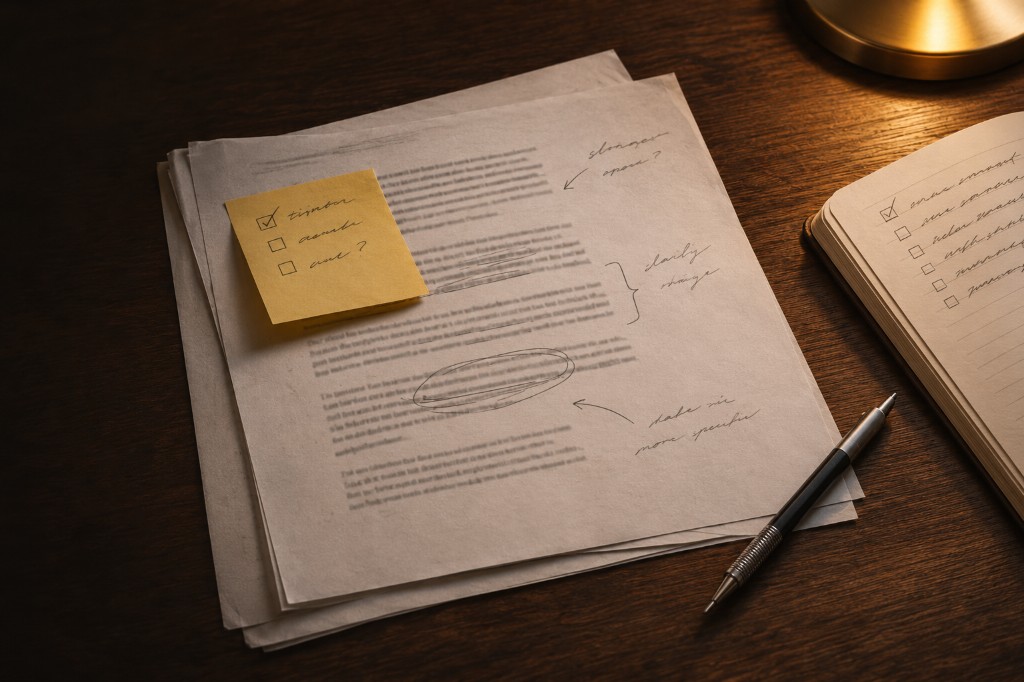
What changes between the first line and the last. If nothing does, the scene is a visit.
Who wants a thing the plot can refuse, and who is only there to nod.
The pressure already on the page, not a twist glued on at the end.
Whose mind we are in, and the sentences that sneak out of it.

The brief
A novel can have a beautiful subject and still be a sequence of scenes in which nothing is risked. We read for the dramatic fact: what this person wants, what it will cost, and whether the scene makes that cost visible. A paragraph about what the moment means is usually a sign the moment did not happen on the page.
Point of view is part of the job. If the book is in one mind, we mark the sentences that know things that mind cannot know. If it moves between people, we mark the move that happens because the draft got bored, not because the story needed another pair of eyes.
How the edit runs
Who wants what, by the end of the first fifty pages. If we cannot say, the reader cannot either.
What each chapter changes. The ones that only visit get marked.
Point of view, explained emotion, and a turn with no pressure under it.
The two or three story problems, with the pages.
Sentences, after the scenes are worth the polish.
Before you send the manuscript
Yes, if the job is a novel or stories. A thriller, a romance, and a quiet literary book are not edited with the same expectations. We name the promise of your shelf before we mark the draft against a different one.
Fiction editing can include that structural pass. If you already know the book holds and you want the scenes and the line, say so. We will not sell you a plot overhaul you do not need.
Yes. Continuity of character and of what the reader was promised in the previous book is part of the edit. Send the earlier book, or a clear brief of what must stay true.
You do. Notes and any revised pages stay yours. We do not take a byline.
When you are ready
That scene usually knows what the rest of the book is avoiding. Call (833) 688-4166 or write [email protected].







The shelf
Our team has helped write, publish and market thousands of books over the past decade. Our books are well-written and finished to perfection. Have a look at some of our ghostwriters’ best works and clients’ bestsellers.


Geeks Ghostwriting’s helped me from idea refinement to publishing. I wanted a script on thriller-romance that had multiple twists and turns. I am directing a movie on the story now and our crew has fallen in love with the story!
Having a drama ghostwritten led me to gain the recognition I was seeking. I had an incomplete manuscript and Geeks Ghostwriting helped me complete it. I marketed it and it sold better than I had expected.
I thought that an illustrative self-help book was not possible! As an established designer, I have always wanted struggling designers and students to learn from my mistakes and achievements. The journey that I thought would be arduous turned out to be enjoyable and simple enough. Thank you, Geeks Ghostwriting!
 Chat with an Expert