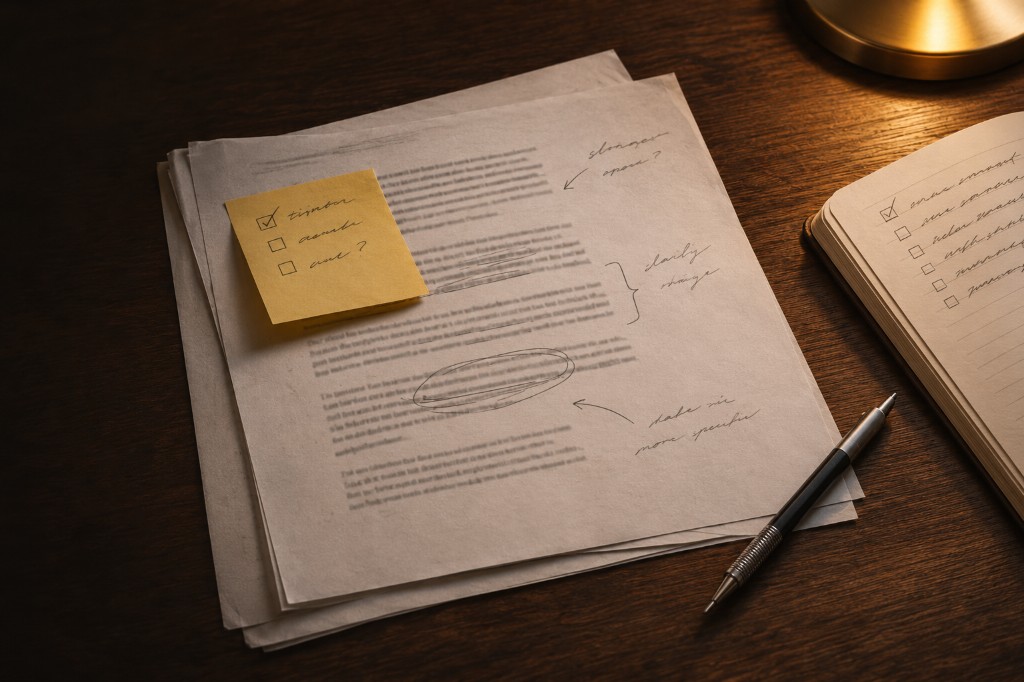
You already have the method. It lives in a deck, a worksheet, and a story you tell on sales calls. A book asks that method to hold still long enough for a stranger to use it without you in the room.
A slide is not a chapterThe awkward step staysNo invented incomePermission in writingYou own the methodA slide is not a chapterThe awkward step staysNo invented incomePermission in writingYou own the method
The four things a useful chapter has to carry
Story
The client, not the trophy.
Named or composite, and we say which. A before-and-after with no middle is an ad. The middle is where your method either shows up or doesn’t. Readers who hire coaches have already seen the trophy version. They bought the book to watch the hour you do not post: the client who stalled, the question you asked twice, the week nothing moved. Without that middle, the story is a slide.
Method
The step you usually skip live.
On a call you can feel the room and jump. On the page the jump looks like magic. Magic does not teach. The awkward step stays in. That is usually the step you are slightly embarrassed by, because it is slower than your reputation. A reader cannot feel the room. They need the question, the order, and what you do when the answer is the one you did not want.
Proof
What you can actually point at.
A number you can stand behind, a work sample, a decision the client made differently. If the only proof is their gratitude, the chapter should say so. Gratitude is not nothing. It is also not a result. We would rather write “she sent the email she had been avoiding” than a revenue claim you cannot show. The smaller true sentence is the one a serious reader trusts, and it is the one that survives a skeptical friend.
Limit
Who this does not fit.
The client you should not take. The problem your framework makes worse. That page is how serious readers decide to trust the rest. A method that claims everyone is a method that has not been used long enough to fail. We will ask for the engagement you refunded, or the room where the exercise went flat. If you will not put a limit on the page, the book will sound like a keynote even when the sentences are careful.
We will read the deck. We will not transcribe it and add chapter titles. If the intellectual property is real, it can survive being slowed down. If it only works at speaking speed, the honest product is the talk, and we will tell you that. Slowing down means the line people photograph has to be followed by the instruction you never had time to give, and by the client it did not save. A deck can skip. A chapter that skips is just the deck with wider margins.
On stage. One story, a turn, a line people photograph.
In the book. The same story, then the step you did not have time to teach, then the client it failed.
An income claim you cannot document. “Clients have made six figures” is not a result if you cannot say who, over what period, and what else they were doing. We will not print the sentence and hope the footnote arrives later.
A healing, a marriage, or a recovery you are not qualified to promise. If the work sits next to therapy, medicine, or the law, the chapter has to say what it is not. A moving story is not a license.
A composite client dressed up as a named one. Composites are allowed when they are labeled. A made-up name with a real company’s private details is not a composite. It is a person your reader might recognize, and we will take the paragraph out.
A method renamed every chapter so the book looks longer than the work. If the framework is one move, the book can be short. Renaming the move does not create a second move. Readers who coach for a living notice, and they are the readers you wanted.
You can, and we prefer that to a stack of old posts. Talking is not the same as a sequence a reader can follow on a Thursday without you. The book is that sequence, plus the stories that show it under strain. We will record the way you teach it live, then put back the step you jumped because the room was with you. That restored step is most of the difference between a transcript and a chapter.
What about my clients’ privacy?
Named stories need permission in writing. Composites get labeled as composites. Details that would identify a private client come out even if they are the best paragraph in the chapter. Industry, city, and the odd specific are often enough to identify someone in a small field. We would rather lose the color than hand you a client who recognizes themselves in a bookstore.
How long, and who owns the method?
You own the method and the book. A clear framework with stories behind it often takes three to five months. If the framework changes every call, the book waits until it stops moving. We will not chase a rename. The months are the interviews, one sample chapter, and then the draft you can still mark up. You are in the calls that decide the sequence. You are not required to become a writer in order to hire one.
Send the ugly version
The worksheet you actually use is more useful than the polished deck.
No perfect pitch needed. Start with what you have.
Our team has helped write, publish and market thousands of books over the past decade. Our books are well-written and finished to perfection. Have a look at some of our ghostwriters’ best works and clients’ bestsellers.
Why Our Customers Love Us
Geeks Ghostwriting’s helped me from idea refinement to publishing.
I wanted a script on thriller-romance that had multiple twists and turns. I am directing a movie on the story now and our crew has fallen in love with the story!
Elizia Cris
Director
Having a drama ghostwritten led me to gain the recognition I was seeking.
I had an incomplete manuscript and Geeks Ghostwriting helped me complete it. I marketed it and it sold better than I had expected.
John Major
Actor
I thought that an illustrative self-help book was not possible!
As an established designer, I have always wanted struggling designers and students to learn from my mistakes and achievements. The journey that I thought would be arduous turned out to be enjoyable and simple enough. Thank you, Geeks Ghostwriting!
Anrora Chao
Designer
Hire The Best Ghostwriters At 70% Off!
To Author Your Timeless Masterpiece.