Letters, deeds, a census, a clipping. What it actually establishes.


Family History & Legacy
A family history has to know the difference between a deed, a letter, a photograph, and the story a reunion keeps telling. The living get a say. The dead do not get invented interiors so the book will feel warm.
Letters, deeds, a census, a clipping. What it actually establishes.
Who repeats the story, and what it protects.
The cousin who will read this and know the street.
Your name on the book, or the family’s, decided in advance.
A tree is an index
If everyone in the book is brave, kind, and unexplained, you have written a eulogy for a century. Eulogies are not history.
Families hire this book for love, and love is not a method. The method is to sort what you hold. A passenger list tells you a year and a port. It does not tell you the mood on the ship. A grandmother’s story tells you what the family needed to remember, which is precious and not the same as a record. We write both without blending them into a scene that feels sourced and is not. The reader, often your own cousin, should be able to tell which sentences come from paper and which come from the table.
Someone in the family will hate a true sentence. A business that failed, a silence about a first marriage, a war record that is less heroic than the toast. We ask, before the draft is lovable, who must be able to live with the book. A legacy project that ambushes a sibling is a family fight with our fingerprints on it. We would rather leave a fact in the archive than print it as a surprise. Secrets can be included when the people who carry them have agreed, or when they are far enough in the past that the living are not being used.
The book needs a question or it becomes a scrapbook with prose. Why this family left. How a house was kept. What a migration cost the people who did not become the successful branch. One question can hold a century better than a chapter per ancestor. Ancestors who leave no trace except a name may get a line. Giving them a personality because the chapter feels short is how family books turn into novels without admitting it.
When you are ready
Letters, a disagreement, or a tree that never became a book. Call (833) 688-4166 or write [email protected].
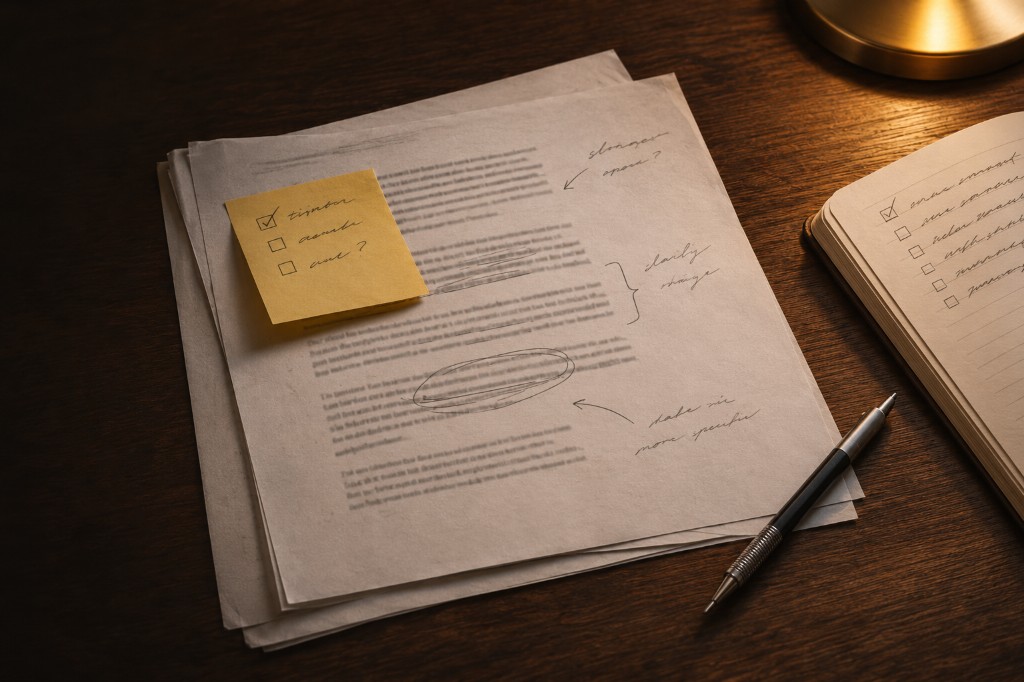
Before the interviews
Boxes, drives, a relative who remembers. A hope that “someone has the records” is not a source. We plan from what you can touch.
A sibling, a parent, the person whose marriage is in the story. Name them. A book with no veto is a book that will detonate at the reunion.
Not “our family.” A departure, a trade, a faith, a house, a silence. If you cannot say it, we are still gathering, and gathering is allowed. Writing can wait.
Order of the work
Beauty is easy to add to a labeled fact. It is hard to remove from a scene the family has already cried over.
Document, interview, or family saying. Each load-bearing tale marked. Contradictions kept. The prettier version does not win by default.
Relatives will not tell the same dinner. That is the book, if they have agreed to be that honest. We do not average them into one fake consensus.
A war, a deed, a newspaper, a ship. Used to check the story, not to drown it. Context is not a textbook chapter unless you asked for a textbook.
The people who must live with it see the hard pages while cuts are still cheap. Tears are not editorial notes. A refusal is.
We will not invent
We can say the record is silent. We cannot loan them our grief or our politics so the paragraph lands.
Every generation a lesson in resilience. The failures, the ordinary decades, and the people who did not become the story belong too, or the book is a brochure.
An adoption, an illness, a shame, printed because it explains a chapter. Not without the person, or not at all if they are gone and the living would be the ones exposed.
The arrival scene nobody wrote down. If you want that, it is fiction, and the book should say it is imagining. We will not counterfeit a memory.
Questions worth asking first
We can organize what a genealogist or a family has found and tell you when a claim is thin. Deep record work is its own trade. We will not invent a link to close a gap, and we will not present a shaky online tree as a discovery. If the book needs an archivist, we say so before we write as if the research is done.
Then we stop and let the family decide. A ghostwriter should not be the one who forces a secret into print because the draft is good. You hired us to make a book the people involved can live beside. If they cannot, the project is not finished by pushing through.
Yes, if you have the right to them. A letter from a dead relative can be the best prose in the book, quoted rather than improved. We do not correct their grammar into our voice. Photos need captions that say what you know, not what you wish the picture proved.
That has to be decided with the family before we start. One person’s copyright in a book built from everyone’s stories is a dispute waiting for the funeral. We can draft under whatever agreement you actually have. We will not assume the person who called us owns the family’s life.






The shelf
Our team has helped write, publish and market thousands of books over the past decade. Our books are well-written and finished to perfection. Have a look at some of our ghostwriters’ best works and clients’ bestsellers.


Geeks Ghostwriting’s helped me from idea refinement to publishing. I wanted a script on thriller-romance that had multiple twists and turns. I am directing a movie on the story now and our crew has fallen in love with the story!
Having a drama ghostwritten led me to gain the recognition I was seeking. I had an incomplete manuscript and Geeks Ghostwriting helped me complete it. I marketed it and it sold better than I had expected.
I thought that an illustrative self-help book was not possible! As an established designer, I have always wanted struggling designers and students to learn from my mistakes and achievements. The journey that I thought would be arduous turned out to be enjoyable and simple enough. Thank you, Geeks Ghostwriting!