What is known, what is guessed, what is being hidden.


Crime Fiction
Crime fiction is the story of what people do once a line has been crossed, and what they were already doing before the siren. Procedure can carry it. So can a family, a precinct, a debt. Gore cannot. Neither can a detective whose only traits are exhaustion and a good line.
What is known, what is guessed, what is being hidden.
Who is protected, and what that protection costs.
A place with a way of handling trouble, not a backdrop.
Cop, reporter, lawyer, neighbor. A job with a method.
The work of the shelf
If the investigation could be done by anyone with the same catchphrase, you have a costume, not a detective.
Crime fiction is a social novel that happens to have a crime in it, or a procedural novel that happens to have a society in it. Both are legitimate. They are not written the same way. A procedural earns trust by showing the next right task: the canvass, the warrant, the interview, the lab that will not hurry. A social crime novel earns trust by showing the life that made the crime possible, and the life that has to continue beside the investigation. We ask which one you are in before we give you a moody investigator and call it a voice.
The victim is the usual place these books get lazy. They are a device for other people’s pain, or a saint, or a sinner who deserved the chapter. We write them as someone who had a Tuesday. A debt, a kindness, a habit that annoyed the person who loved them. When the victim is specific, the investigation has something to find besides a culprit. It has a life that was interrupted, and the people who want that interruption explained in a way that does not embarrass them.
Procedure is not the opposite of character. The way a person runs an interview is character: who they let talk, who they interrupt, what they pretend not to notice so they can use it later. We would rather show a detective’s method than give them a tragic paragraph and a drink. The drink can stay if it is doing work. The tragic paragraph usually is not. Wit is welcome when it is how this person handles fear or boredom. Wit as the whole personality is a television habit, and it reads thin by chapter five.
When you are ready
The mood can wait until the file makes sense. Call (833) 688-4166 or write [email protected].
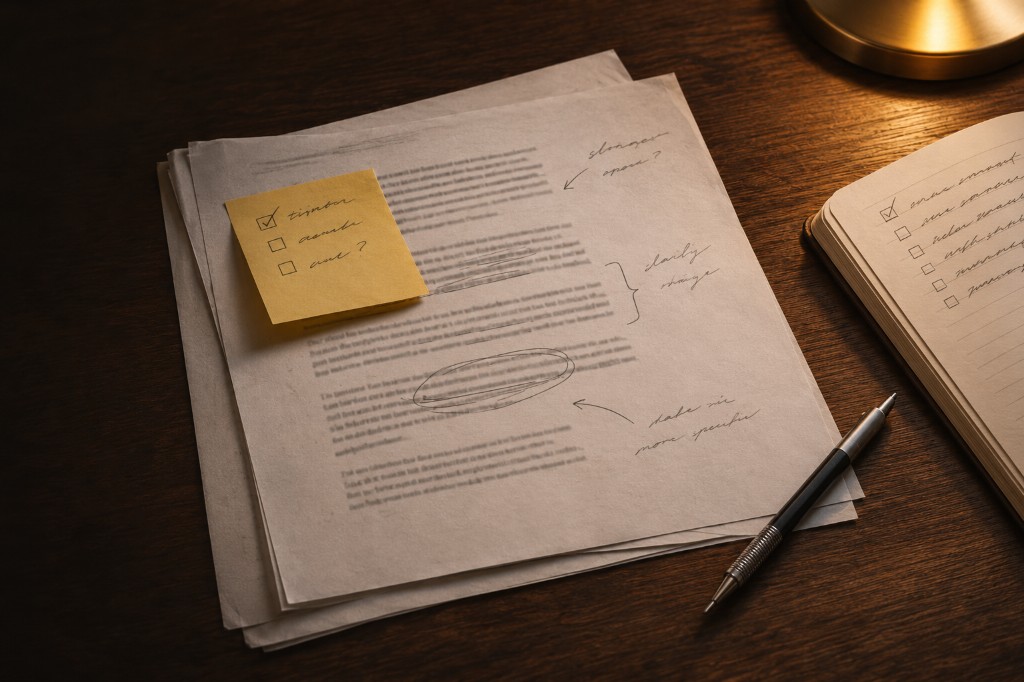
What the desk needs first
Who is allowed to ask questions, and under what rule. A police officer, a private client, a journalist, a sister who was never deputized. The book changes completely with that answer. An amateur can investigate. They cannot do it with the powers of a sergeant unless the book is willing to be fantasy.
Justice is a large word and a weak engine. We want the practical stake. A case that will be closed badly if they are slow. A witness who will recant. A career, a parole, a child in a house that is not safe. The moral point lands harder when the practical one is clear.
How this city, town, or institution handles a crime like this one. Who is believed. Who is processed quickly. What the neighbors already know and will not say to a stranger. Crime fiction with no local habit is a plot in a rental unit.
The order we work in
Atmosphere is what a room feels like after we know who is lying. Written first, it becomes weather, and weather does not solve or complicate a case.
What is known on day one. What is learned, and by what means. What is still a guess at the end. We write this as a short document. The novel has to be able to survive being told that plainly, or the style is covering a hole in the case.
Their method, their limit, and the one rule they will break. That rule should be specific to the job. Not a generic willingness to be violent. A detective who breaks a rule they believe in is more interesting than one who never had a rule.
Family, partners, coworkers, the person who benefited. Each gets a reason to cooperate and a reason not to. Scenes with them are not breaks from the plot. They are the plot, if the book is about a world and not only a puzzle.
Arrest, exposure, a deal, a silence someone has to live with. The ending should be possible with the tools this investigator actually had. A confession that arrives because the book is tired is the same cheat in crime fiction as it is in a thriller.
We will not lean on these
Shock is a short effect. If the scene’s only news is an injury, we cut to the decision the injury forces, or we cut the spectacle.
Those can be notes in a voice. They are not a method, a past, or a reason to trust the investigation.
We will not make them a symbol of the city, or of the detective’s guilt, unless the book has also let them be someone with errands and affections.
If the institution is dirty, we name the favor, the budget, the person who benefits. A general stain is not a plot. A specific bargain is.
Questions worth asking first
It overlaps both and is not owned by either. A crime novel can be a fair puzzle, a procedural, or a book about the people around an offense that the reader already understands. The constant is the social and practical fact of the crime. If your pages are mostly a chase, we should talk about thrillers. If they are mostly a question of who, we should talk about mystery. If they are about how a place deals with what happened, you are here.
No. You need a willingness to be accurate about the job you chose to depict. We will not write a cop who does whatever the plot wants and call it realism. If you know the work, we will use what you know. If you do not, we keep the method inside what can be checked, and we do not invent powers to speed a chapter up.
Only with care, and only after we talk about the living people. A public record is not a free pass to invent the private life of a victim or a family. If your book is close to a real offense, say so before any pages are drafted. We would rather refuse a version that uses someone’s grief as texture than write it and tidy the worry later.
You do. The copyright is yours, including the casework and the chapters written here. We do not retell your plot in a pitch, a sample, or a conversation that names you. Crime premises travel fast. They will not travel from this desk.





The shelf
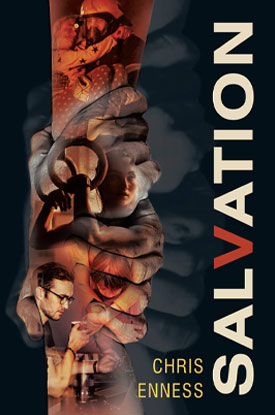
Our team has helped write, publish and market thousands of books over the past decade. Our books are well-written and finished to perfection. Have a look at some of our ghostwriters’ best works and clients’ bestsellers.



Geeks Ghostwriting’s helped me from idea refinement to publishing. I wanted a script on thriller-romance that had multiple twists and turns. I am directing a movie on the story now and our crew has fallen in love with the story!
Having a drama ghostwritten led me to gain the recognition I was seeking. I had an incomplete manuscript and Geeks Ghostwriting helped me complete it. I marketed it and it sold better than I had expected.
I thought that an illustrative self-help book was not possible! As an established designer, I have always wanted struggling designers and students to learn from my mistakes and achievements. The journey that I thought would be arduous turned out to be enjoyable and simple enough. Thank you, Geeks Ghostwriting!