Structure
We trace what each chapter does for the book, and which ones only repeat a point the reader already holds.

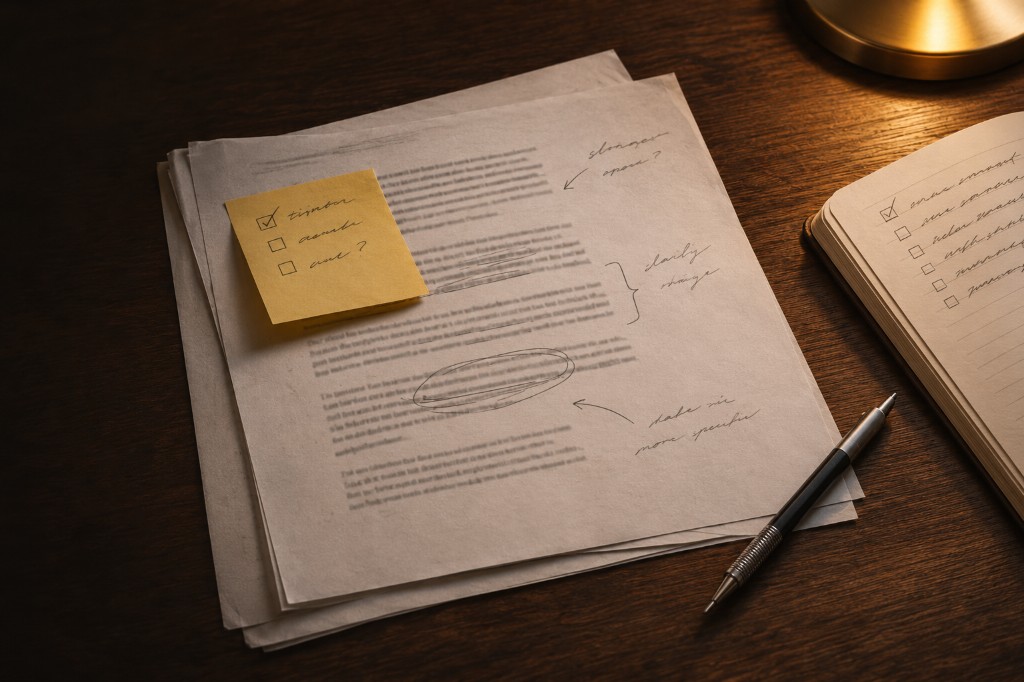
Developmental editing looks at the architecture of a manuscript before anyone polishes a sentence. Plot, argument, character, pace, and the promise you made the reader on page one. You leave with an editorial letter, a chapter map, and a revision plan you can actually use.

We trace what each chapter does for the book, and which ones only repeat a point the reader already holds.
Who changes, who only agrees, and which characters the story could lose without the reader noticing.
Where the draft earns attention, and where it explains, recaps, or arrives at a turn the reader never felt coming.
The bargain struck in the opening, checked against the ending the manuscript actually delivers.

The brief
Line editing and proofreading make the sentences clean. Developmental editing asks a harder question first: does the book hold together? We read the full draft the way a careful reader does, then write an editorial letter that names what the book is trying to be and the exact places it loses that aim.
The letter arrives with a map. Chapters that carry the story. Chapters that circle a scene you already wrote. A reveal that lands flat because the pressure was never planted. An ending that belongs to a different book than the one the opening promised. Memoir and argued nonfiction get the same test: a claim that collapses under its own example, or a chapter of advice with no lived scene underneath it.
How the work runs
We read the whole draft once, unmarked, so we meet it the way your reader will.
Two or three structural problems that actually change the book, named in plain language.
Chapter by chapter: what it owes the reader, what it delivers, and what it should stop doing.
You push back. A useful edit survives disagreement. Polite praise does not fix a weak middle.
A revised order of the book. Line editing starts only after this shape holds.
Before you send the manuscript
A complete draft is the cleanest start. A partial manuscript can still be read if the premise is clear and you know where you are stuck. A folder of notes is a different service. Before any work begins, we will tell you which one you have brought.
No. Ghostwriting builds the pages. Developmental editing reads pages that already exist and tells you what has to move. If the honest note is that the book should be rewritten, we say that before a new draft starts.
Only after the map is agreed. Some authors take the letter and revise the book themselves. Others ask us to rebuild the chapters to that shape. Both are real jobs. They are scoped and priced as different jobs.
You do. The notes, the letter, and any pages drafted here remain yours. We do not put our name on the cover, and we do not reuse your premise as a sample that could be traced back to you.
When the draft is ready
A full file is ideal. The chapter where you stopped trusting the book is enough for us to tell you whether this pass is the right one. Call (833) 688-4166 or write [email protected].







The shelf
Our team has helped write, publish and market thousands of books over the past decade. Our books are well-written and finished to perfection. Have a look at some of our ghostwriters’ best works and clients’ bestsellers.


Geeks Ghostwriting’s helped me from idea refinement to publishing. I wanted a script on thriller-romance that had multiple twists and turns. I am directing a movie on the story now and our crew has fallen in love with the story!
Having a drama ghostwritten led me to gain the recognition I was seeking. I had an incomplete manuscript and Geeks Ghostwriting helped me complete it. I marketed it and it sold better than I had expected.
I thought that an illustrative self-help book was not possible! As an established designer, I have always wanted struggling designers and students to learn from my mistakes and achievements. The journey that I thought would be arduous turned out to be enjoyable and simple enough. Thank you, Geeks Ghostwriting!
 Chat with an Expert