A break that changes the meaning, not a margin the sentence hit.


Poetry
A poem has to put pressure on a line the way a scene puts pressure on a person. A collection needs a reason these poems are in one book. Images with nothing at stake are not a manuscript. They are a mood you have not made choose.
A break that changes the meaning, not a margin the sentence hit.
A person is speaking, even when the poem refuses to name them.
The sequence is an argument, not a folder sorted by date.
Your name on the book. The lines stay yours.
What we are actually revising
If the best line only works as a caption for the rest, the rest is a setup and the line is doing charity.
Most drafts we see are either afraid of prose or afraid of being understood. The first wraps a simple observation in so many gestures that the reader cannot find the pressure. The second says the feeling in the opening lines and then spends a page agreeing with itself. We look for the moment the language has to turn because the situation turned: a name used once, a tense that shifts, a line that is shorter because the speaker could not finish the social version of the sentence.
Form is welcome when it is the point. A sonnet that is a sonnet because the argument needs the turn at the ninth line is a pleasure to work on. A sonnet that is a sonnet because the word count of the feeling came out near fourteen is a costume, and the costume will be the first thing a serious reader hears. We will write in a form you can hear. We will not pour your material into one so the manuscript looks harder.
A collection is built by subtraction and by order. Poems that solve the same problem with the same image are drafts of one poem, and keeping all of them makes the book seem less confident, not more abundant. We read for the spine: a place, a grief with a specific object, a job, a faith, a body that has to keep a schedule. Then we set the poems so the book changes temperature on purpose. Chronological order is sometimes right. It is not the default of seriousness.
When you are ready
A sheaf, a single stuck poem, or a book that does not know its order. Call (833) 688-4166 or write [email protected].
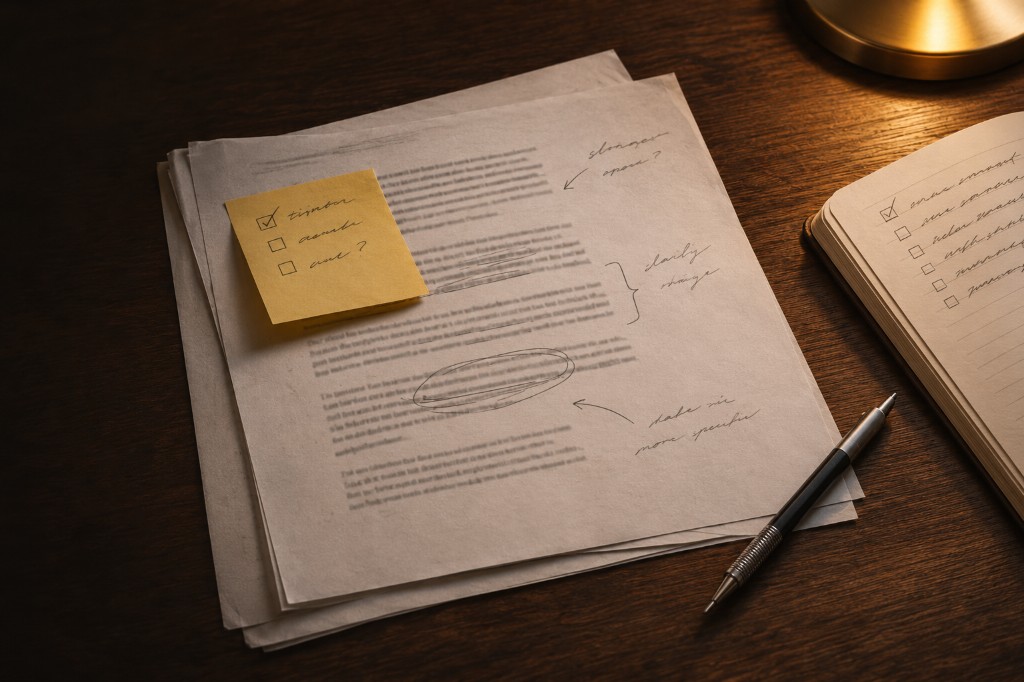
Before we touch a line
Even a poem that hides the speaker has a pressure of address. A diary aimed at nobody tends to explain itself. Tell us who cannot be told this in ordinary speech.
Not the theme. The unpaid bill, the diagnosis, the child asleep in the next room, the shift that starts at five. Abstraction can stay if the stake is somewhere on the page.
If you already know three poems that do not belong, say so. The argument of a collection often starts with the piece you are protecting for the wrong reason.
Order of the work
Generating more lines is easy. Knowing which existing lines are already the book is the actual job.
We mark the image, the syntactic trick, and the emotional landing you use more than once. One of each can be the signature. The fourth is a stall.
We test breaks by reading the line as its own sentence and then as part of the next. If both readings are accidental, the break is only visual, and we move it or we rewrite the sentence until the break is forced.
If the book is missing a temperature, a season, or a counterargument, we draft toward that hole. We do not add poems because the manuscript looks short. Short is allowed.
Last, we read the book in order, including the titles. Titles that explain the poem are usually fear. Titles that are the poem’s best line, stolen from the ending, are usually a loss. We will argue about both.
We will not call these finished
Music is not enough. If nothing in the poem could go wrong, the line is a compliment the writer paid themselves.
The turn can be last. The explanation of the turn cannot. We cut the sentence that tells the reader how to feel about the image they just received.
We can hear it, and so will anyone who has that book on the desk. Influence can be a rhythm you argue with. It cannot be a voice you borrow for the whole collection.
Hope is allowed. A last line that could be printed on a mug, after a poem that was actually strange, is a retreat. We would rather stop on the strange line.
Questions worth asking first
Yes, if the pressure, the images, and the life are yours to give. We are not interested in inventing a persona from a mood board and calling it your book. Bring the facts, the sentences you cannot get right, and the poems you suspect are dead. Ghostwriting here means the craft and the arrangement stay invisible. The mind has to be supplied.
Both, when the form has a reason. We will not force a villanelle to prove skill. If you want a formal book, say which constraints you can hear and which you only think you should want. A broken form, used once and on purpose, is often more honest than a correct one kept for forty pages.
Fragments are a start when they contain a concrete pressure. A list of topics is not a start. We can sit with the fragments and find which ones are poems refusing to end, and which are notes toward poems that have not chosen a speaker. Expect to lose some. That loss is the work.
You do. The copyright is yours, including lines drafted at this desk and the order of the manuscript. We do not publish, perform, or teach your images as ours. Poetry is easy to identify. We treat that as a reason to be quieter, not as a reason to blur the credit.






The shelf
Our team has helped write, publish and market thousands of books over the past decade. Our books are well-written and finished to perfection. Have a look at some of our ghostwriters’ best works and clients’ bestsellers.


Geeks Ghostwriting’s helped me from idea refinement to publishing. I wanted a script on thriller-romance that had multiple twists and turns. I am directing a movie on the story now and our crew has fallen in love with the story!
Having a drama ghostwritten led me to gain the recognition I was seeking. I had an incomplete manuscript and Geeks Ghostwriting helped me complete it. I marketed it and it sold better than I had expected.
I thought that an illustrative self-help book was not possible! As an established designer, I have always wanted struggling designers and students to learn from my mistakes and achievements. The journey that I thought would be arduous turned out to be enjoyable and simple enough. Thank you, Geeks Ghostwriting!